Thyroid Nodule Size Chart: What 1 cm, 2 cm and 4 cm Nodules Mean
Thyroid nodule size chart in mm and cm: which sizes need a biopsy, when surgery is considered, and how the TI-RADS score changes the picture. Written for patients reading their ultrasound report.
If you are reading this with an ultrasound report in your hand, you probably want one thing: to know whether the number written next to “nodule” is a problem. Here is the honest answer up front. Thyroid nodule size matters, but it almost never decides anything on its own. A 6 mm nodule with suspicious features can need a biopsy, while a smooth 3 cm cyst may only need a check-up next year. What decides the next step is thyroid nodule size combined with how the nodule looks on ultrasound.
Thyroid nodules are extremely common. Ultrasound finds them in roughly half of adults over 50, and most people never know they have one. Around 90 to 95 percent are benign. This guide gives you the thyroid nodule size chart doctors actually use, explains the 1 cm and 4 cm thresholds you will keep hearing about, and shows how the TI-RADS score on your report changes the picture.
Thyroid Nodule Size Chart (mm and cm)
The chart below is a simplified version of what an endocrinologist has in mind when reading your scan. It assumes an average-looking nodule; the TI-RADS section further down explains how suspicious features shift every line upward.
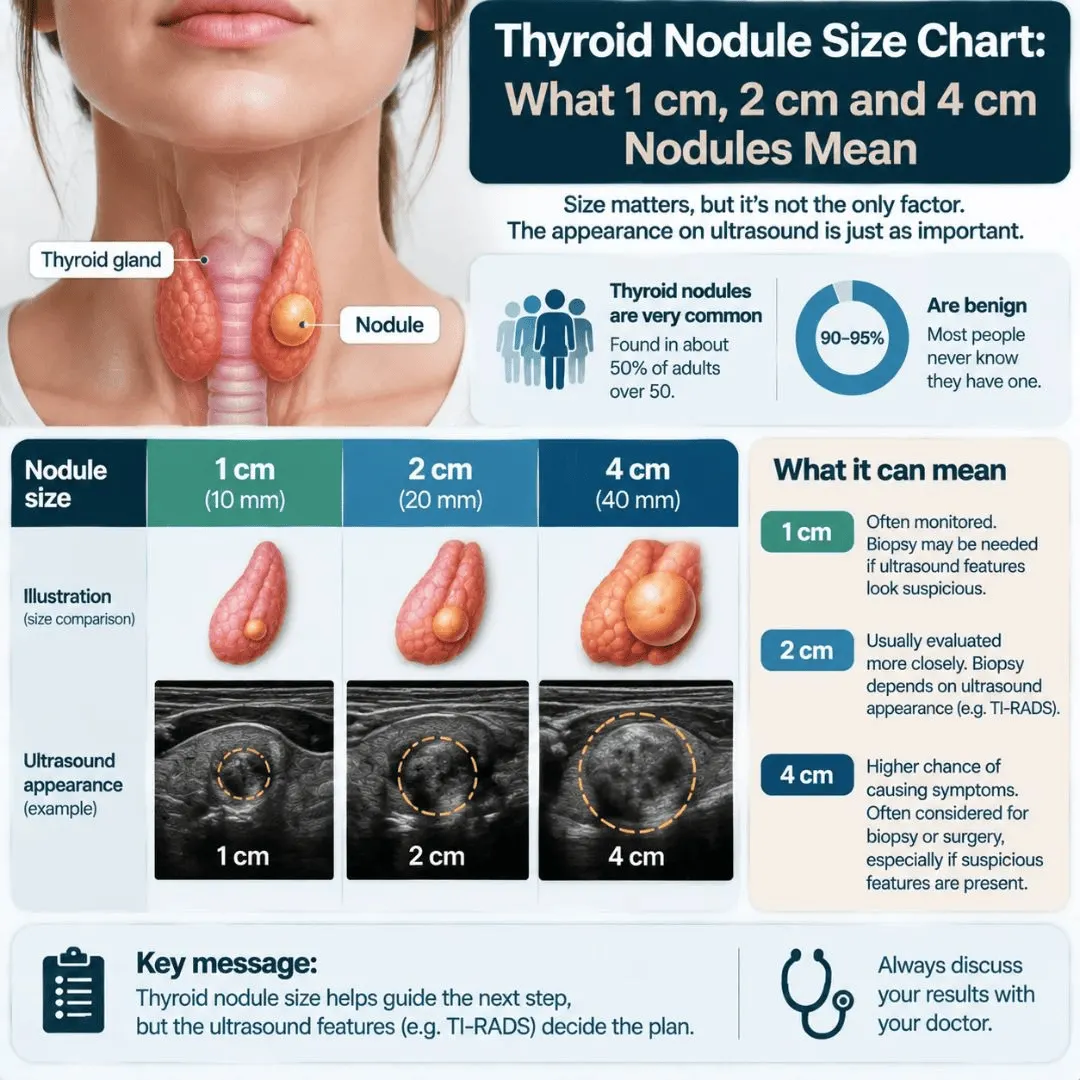
| Thyroid nodule size | What it usually means | Biopsy? | Typical follow-up |
|---|---|---|---|
| Under 5 mm | Incidental finding, very common | No | Often none, or one repeat scan |
| 5–10 mm | Small nodule | Only if highly suspicious on ultrasound | Ultrasound in 12–24 months |
| 1–2 cm | The size at which evaluation starts | Yes, if intermediate or high suspicion | Ultrasound in 12 months |
| 2–4 cm | Larger nodule; may be felt or seen | Usually yes | Ultrasound in 6–12 months if benign |
| Over 4 cm | Large nodule | Yes | Surgery is often discussed |
Two things to keep in mind. First, “size” on your report may be given as three measurements; doctors use the largest one. Second, a nodule that is mostly fluid (a cyst) is treated more leniently than a solid nodule of the same size.
What Size Thyroid Nodule Is Concerning?
The short answer: a thyroid nodule becomes “concerning” enough to investigate at about 1 cm (10 mm), and “concerning” enough to consider surgery at about 4 cm. Between those two numbers, the ultrasound appearance decides.
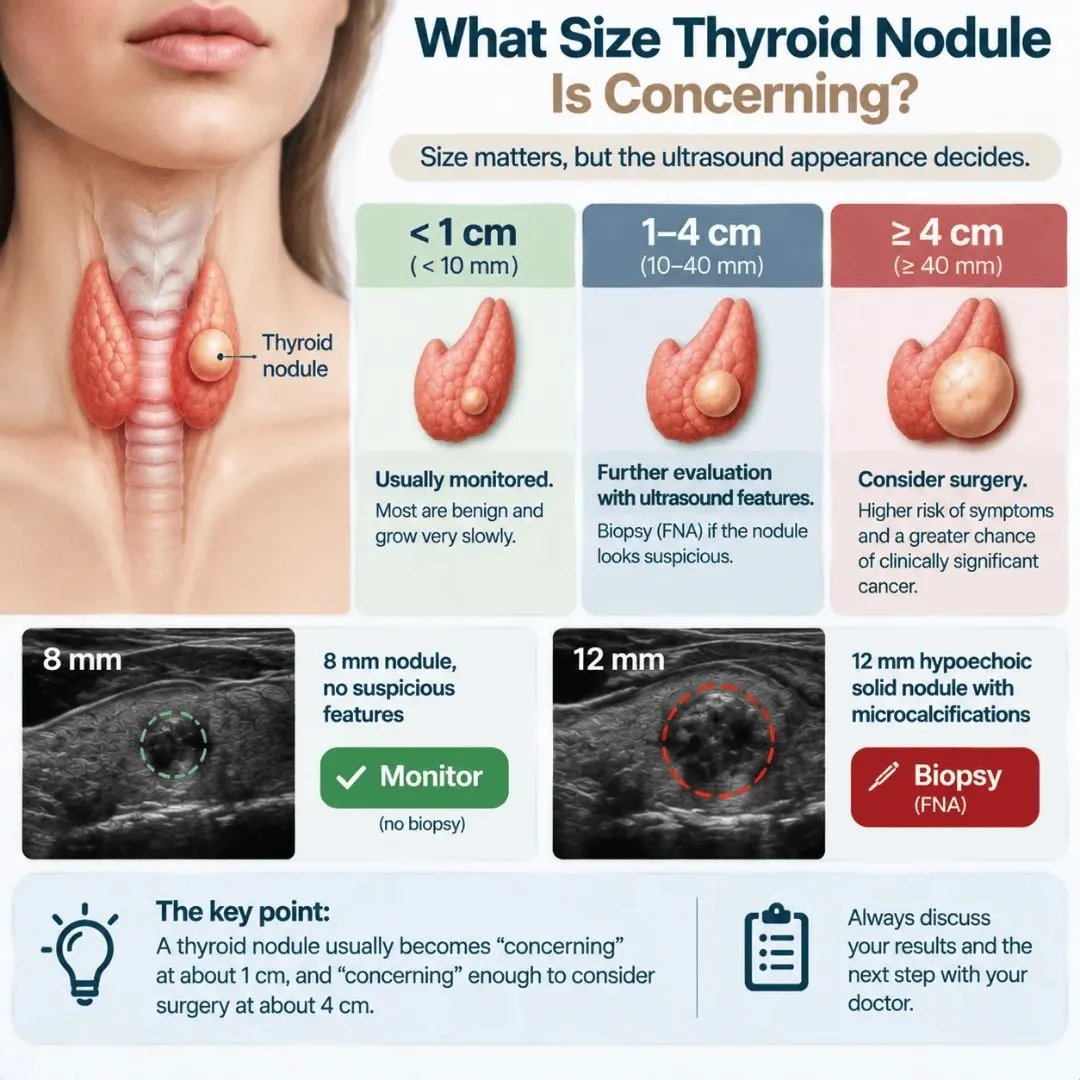
Why 1 cm? Below that size, even a nodule that turns out to be cancer is usually a papillary microcarcinoma, which grows very slowly and rarely spreads. Biopsying every tiny nodule would mean a lot of needles for very little benefit. Above 1 cm, a cancer is more likely to matter clinically, so that is where guidelines from the American Thyroid Association and the American College of Radiology begin recommending a fine-needle aspiration (FNA) when the nodule also looks suspicious.
So if your report says “8 mm nodule, no suspicious features,” you are in the group that is watched, not biopsied. If it says “12 mm hypoechoic solid nodule with microcalcifications,” you are in the group that is biopsied.
Is a 1 cm Thyroid Nodule Dangerous?
A 1 cm thyroid nodule is not dangerous in itself. It is the size at which doctors start looking more closely, which is a different thing. Most 1 cm thyroid nodules are benign colloid nodules or small cysts.
What happens next depends on the ultrasound. A 1 cm nodule that is spongy, mostly cystic or clearly benign-looking is usually rechecked in a year or two. A 1 cm nodule that is solid, darker than the surrounding thyroid, taller than it is wide, or contains tiny bright calcifications is biopsied, because those are the features linked to thyroid cancer. The biopsy is an outpatient needle test that takes about fifteen minutes.
2 cm and 3 cm Thyroid Nodules: What Changes
Once a thyroid nodule reaches 2 cm, three things change. It is large enough to be felt in the neck by an experienced examiner. It is large enough that a biopsy is recommended even when the ultrasound looks only mildly suspicious. And it becomes worth asking whether it is producing too much thyroid hormone, so a blood test (TSH) is usually added if not already done.
A 3 cm thyroid nodule is at the upper end of what is comfortably followed without treatment. Many 3 cm nodules are benign and never cause trouble, but at this size some people start to notice a visible lump, a feeling of pressure when swallowing, or hoarseness if the nodule presses on the voice nerve. If a 3 cm nodule is benign on biopsy and causes no symptoms, watching it is reasonable. If it is growing or causing symptoms, treatment is discussed even without cancer.
Thyroid Nodule Size for Surgery
There is no law that says a nodule must be removed at a certain size, but 4 cm is the number most surgeons use as a threshold to bring up surgery. The reasons are practical. Above 4 cm, a needle biopsy samples a smaller fraction of the nodule, so a benign result is slightly less reliable. Large nodules are more likely to press on the windpipe or esophagus. And a 4 cm nodule is unlikely to shrink on its own.
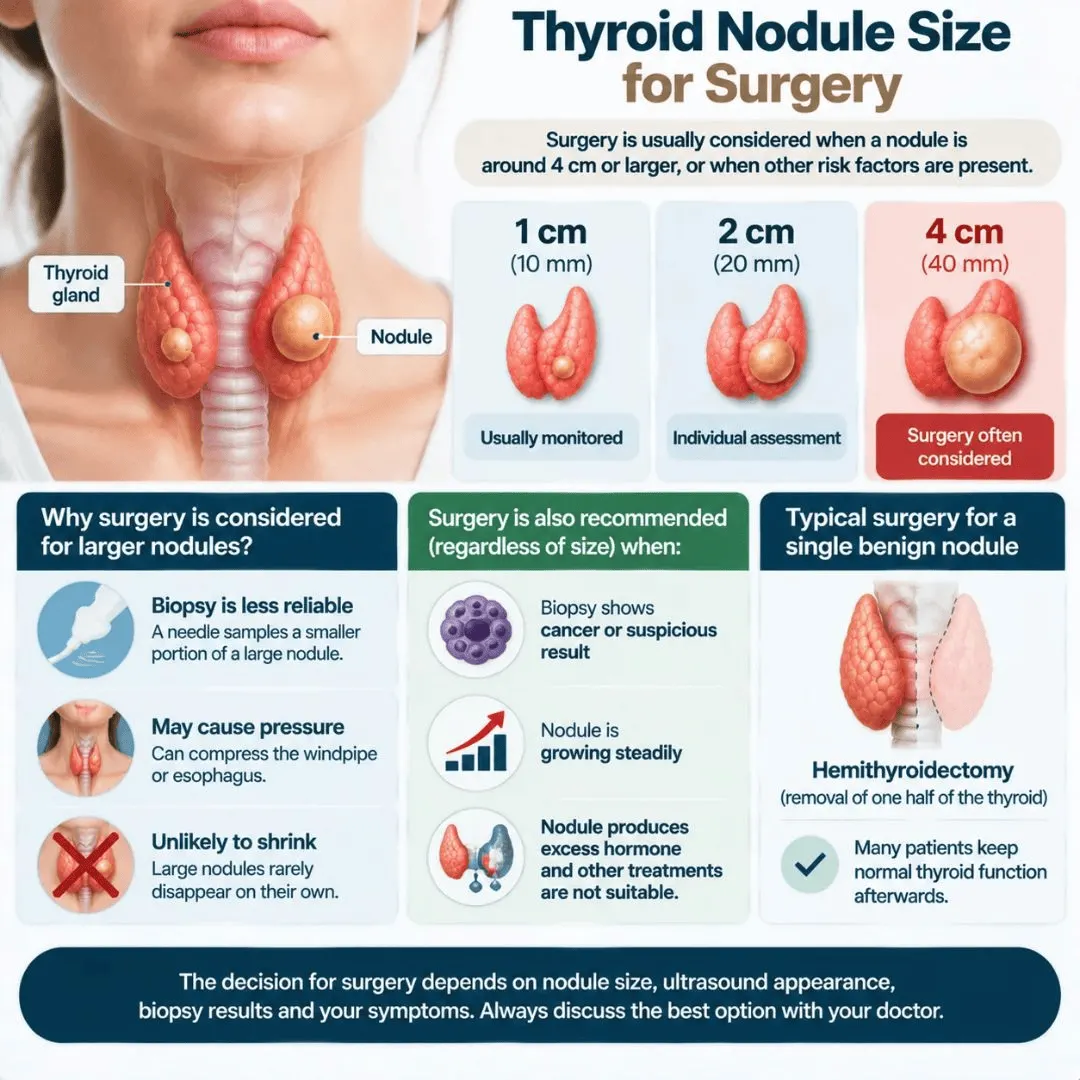
Surgery is also recommended, regardless of size, when the biopsy shows cancer or a suspicious result, when a nodule is growing steadily, or when it produces excess hormone and other treatments are not suitable. For a single benign nodule, removing half of the thyroid (hemithyroidectomy) is usually enough, and many patients keep normal thyroid function afterwards.
TI-RADS Score and Nodule Size: Reading Your Ultrasound Report
Most modern ultrasound reports include a TI-RADS category from TR1 to TR5. It is a score built from five features: composition, echogenicity (how dark the nodule is), shape, margin, and calcifications. The score sets the size at which a biopsy is recommended, which is why two nodules of the same size can get different advice.
| TI-RADS category | Suspicion level | Biopsy if nodule is at least | Follow-up ultrasound if at least |
|---|---|---|---|
| TR1 | Benign | Not needed | Not needed |
| TR2 | Not suspicious | Not needed | Not needed |
| TR3 | Mildly suspicious | 2.5 cm | 1.5 cm |
| TR4 | Moderately suspicious | 1.5 cm | 1 cm |
| TR5 | Highly suspicious | 1 cm | 0.5 cm |
Read your report against this table. A “TR3, 1.8 cm” nodule is watched. A “TR5, 1.1 cm” nodule is biopsied. This single table answers most of the size questions patients bring to us.
Thyroid Nodule Cancer Risk by Size
Roughly 5 to 10 percent of thyroid nodules that are evaluated turn out to be cancer. Size raises that risk only modestly. In large series, nodules under 1 cm and nodules over 4 cm have surprisingly similar cancer rates; what climbs steeply with the TI-RADS category is the risk, not the size. A TR2 nodule has a cancer risk under 2 percent at any size; a TR5 nodule has a risk above 20 percent even when small.
That is worth repeating, because it is the most common misunderstanding we meet: a large thyroid nodule is not automatically more likely to be cancer, and a small one is not automatically safe. Appearance beats size.
Can a Thyroid Nodule Shrink or Go Away?
Yes, some can. Nodules that are mostly fluid can shrink or disappear, and a purely cystic nodule that is drained with a needle may not come back. Solid nodules rarely disappear, but many stay the same size for years, and a benign nodule that has not grown over several scans can often have its follow-up spaced out or stopped.
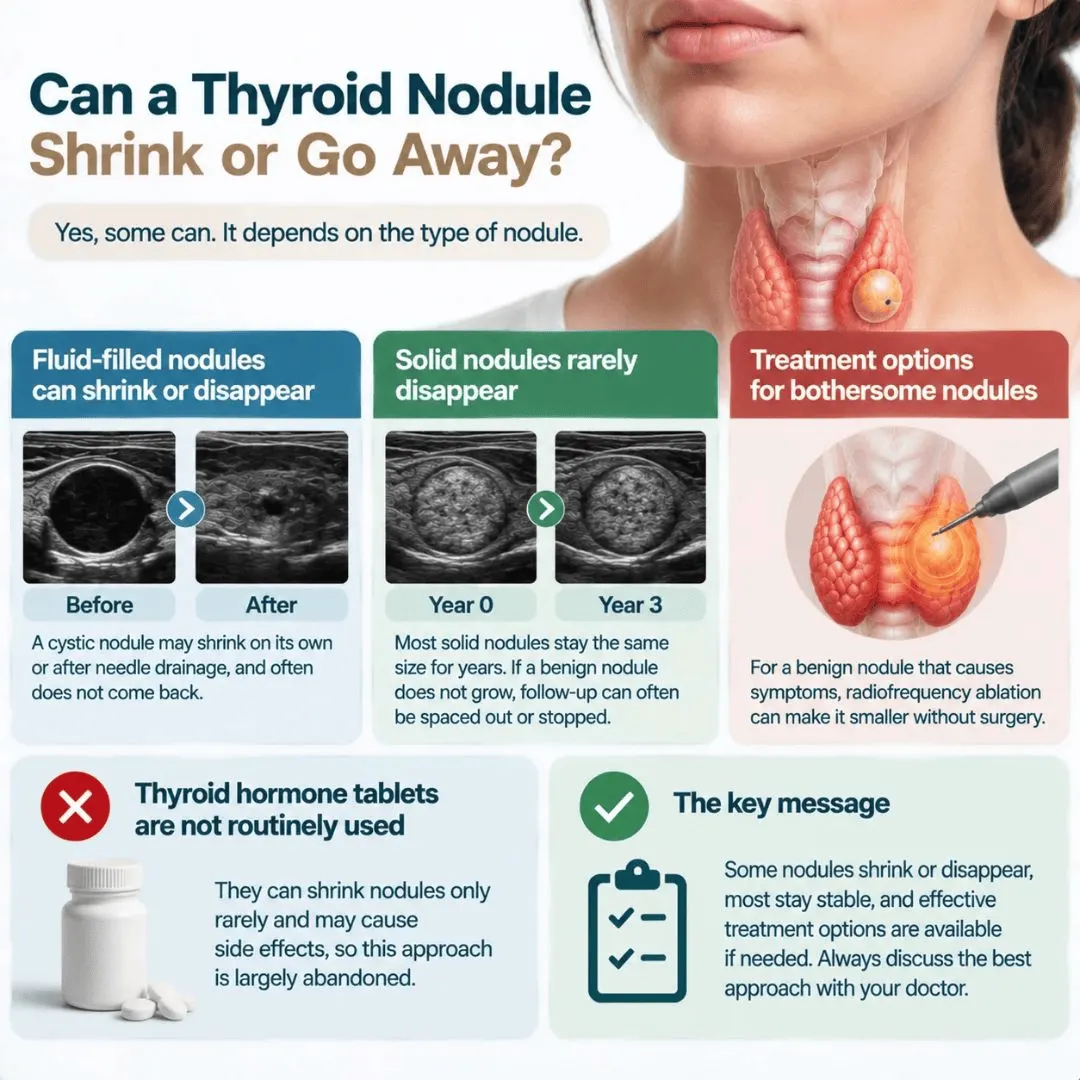
Thyroid hormone tablets used to be prescribed to shrink nodules; that approach has largely been abandoned because it works poorly and carries side effects. For a benign nodule that is bothersome, radiofrequency ablation, covered below, is now the usual way to make it smaller without surgery.
How Fast Do Thyroid Nodules Grow?
Most thyroid nodules grow slowly or not at all. When doctors talk about “significant growth,” they mean an increase of at least 20 percent in two dimensions with a minimum of 2 mm, or more than 50 percent in volume, between scans. A nodule that goes from 11 mm to 12 mm has not grown in any meaningful sense; measurement alone varies by a millimetre or two between machines and operators.
Rapid growth over weeks, especially with pain or hoarseness, is different and should be checked promptly, though even then the cause is more often bleeding into a benign nodule than cancer.
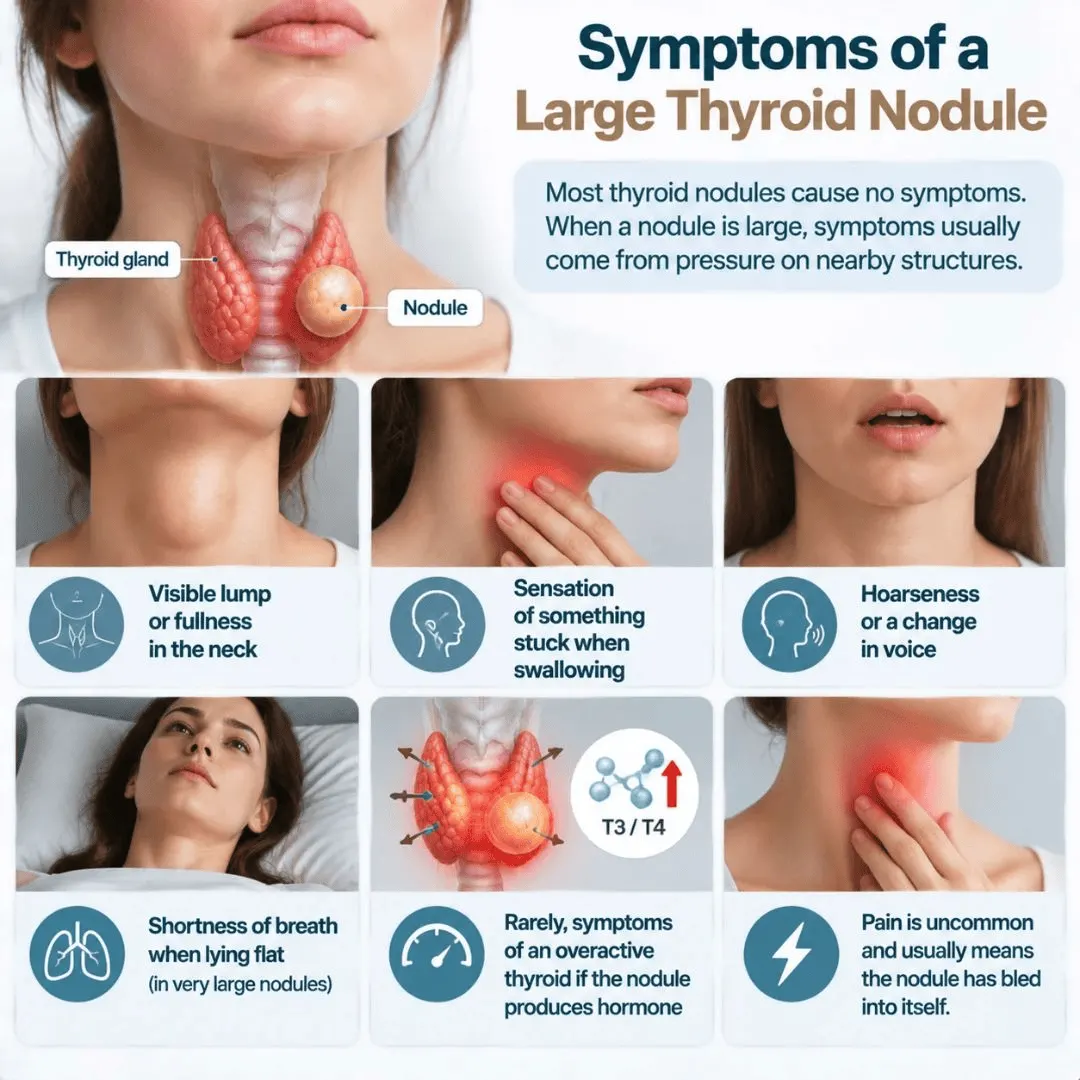
Symptoms of a Large Thyroid Nodule
Most thyroid nodules, whatever their size, cause no symptoms and are found by chance on a scan done for another reason. When a large thyroid nodule does cause symptoms, they come from pressure:
- a visible lump or fullness at the front of the neck
- a sensation of something stuck when swallowing
- hoarseness or a change in voice
- shortness of breath when lying flat, in very large nodules
- rarely, symptoms of an overactive thyroid if the nodule produces hormone
Pain is uncommon and usually means the nodule has bled into itself.
Thyroid Nodule Treatment Options by Size
Treatment follows the biopsy result and the size, in that order. A benign nodule under 2 cm with no symptoms is simply followed with ultrasound. A benign but bothersome nodule of 2 to 4 cm can be treated with radiofrequency ablation (RFA), a needle procedure under local anaesthesia that shrinks the nodule by 50 to 80 percent over months without a scar. Cystic nodules can be drained, sometimes with alcohol injection to prevent refilling. Nodules over 4 cm, growing nodules, and any nodule with a suspicious or malignant biopsy are treated surgically. When the whole thyroid is removed, lifelong thyroid hormone replacement is needed; after removal of one lobe it often is not.
Thyroid Nodule Evaluation and Treatment in Turkey with MPGCARE
A good part of the people who write to us about a thyroid nodule have been waiting months for a biopsy or an endocrinology appointment at home. In Turkey the entire evaluation — high-resolution ultrasound with TI-RADS scoring, fine-needle biopsy with results in a few days, and a consultation with an endocrinologist and, if needed, an endocrine surgeon — fits into one visit. Radiofrequency ablation for benign nodules is widely available, and thyroid surgery is performed in high-volume centres with nerve monitoring to protect the voice.
MPGCARE coordinates this with accredited partner hospitals in Istanbul, Ankara and Izmir, arranges flights, accommodation and transfers with an interpreter, and can add a full health check-up if you want the rest of your health reviewed in the same trip. Send your ultrasound report through our online assessment form and a specialist tells you, before you book anything, whether your nodule needs a biopsy, ablation, surgery or simply another scan.
Frequently Asked Questions
What size thyroid nodule needs a biopsy?
It depends on the TI-RADS category: 1 cm for highly suspicious (TR5) nodules, 1.5 cm for moderately suspicious (TR4), and 2.5 cm for mildly suspicious (TR3). Benign-looking nodules are not biopsied at any size.
Is a 5 mm thyroid nodule anything to worry about?
Almost never. Nodules this small are extremely common and are not biopsied even when they look suspicious; at most they are rechecked with ultrasound after a year or two.
Can a benign thyroid nodule become cancerous?
It is rare. A nodule with a benign biopsy has well under a 3 percent chance of being reclassified later, and most of those are sampling errors rather than true change. Steady growth or new suspicious features on ultrasound are the reasons to repeat the biopsy.
What is the normal size of the thyroid gland?
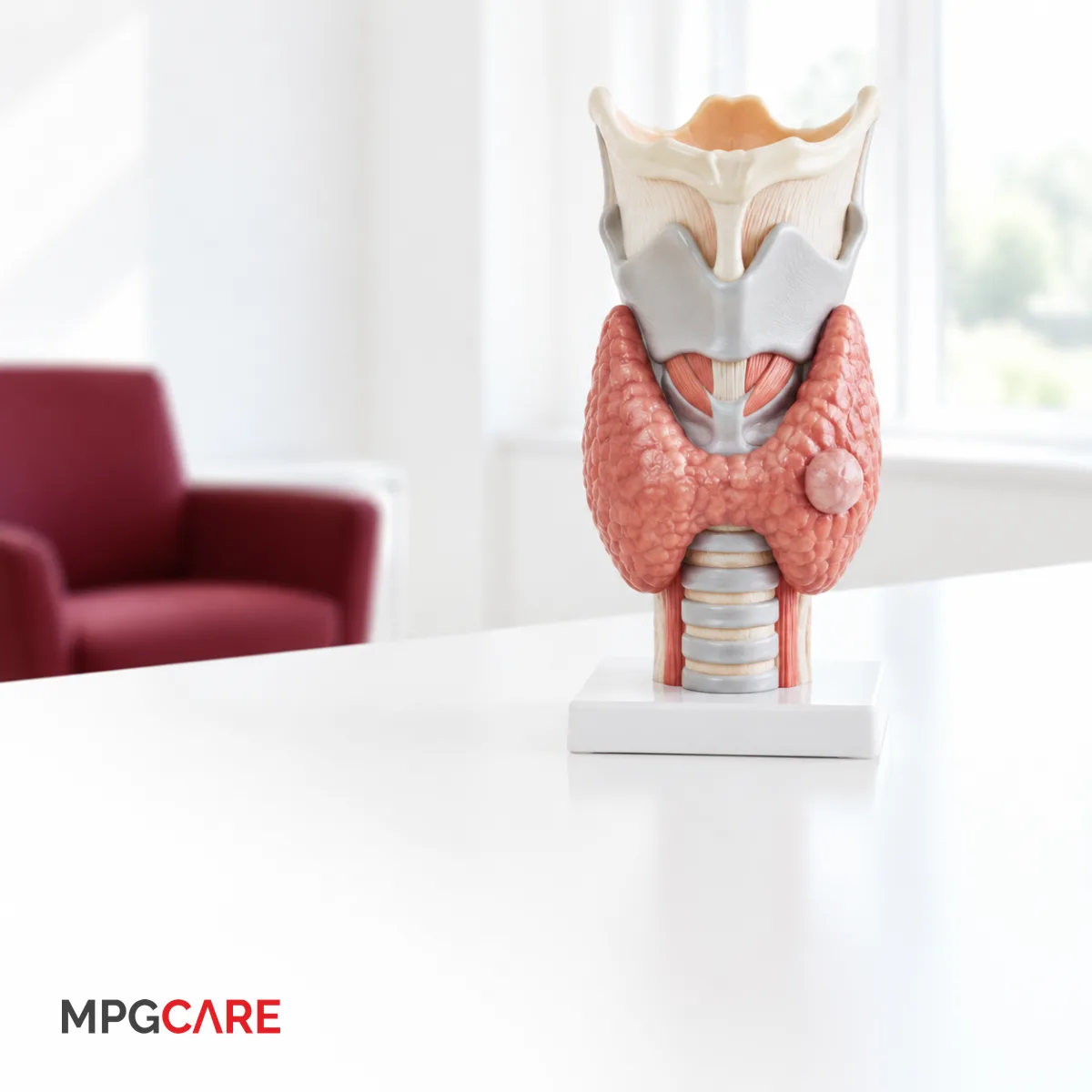
Each lobe is about 4 to 6 cm long and 1.5 to 2 cm wide and thick in an adult. A gland larger than this is called a goitre, whether or not it contains nodules.
How often should a thyroid nodule be checked?
A benign nodule is usually rescanned after 12 to 24 months. If it is unchanged on two or three scans, the interval can be extended or follow-up stopped. Nodules that were not biopsied because they were small are checked according to their TI-RADS category.
Do I need surgery for a 3 cm thyroid nodule?
Not automatically. If the biopsy is benign and you have no symptoms, a 3 cm nodule can be watched or treated with ablation. Surgery is considered if it grows, causes pressure symptoms, or the biopsy is not clearly benign.
This article is for general information and does not replace an evaluation by an endocrinologist. Size thresholds are based on the American Thyroid Association and ACR TI-RADS guidelines and should be interpreted together with your own ultrasound and biopsy results.