
Inguinal Hernia Symptoms
Inguinal hernia symptoms usually include a noticeable groin bulge, pain that worsens with movement, and a pulling sensation. When detected early, an inguinal hernia can be managed before possible complications develop.
Symptoms of an inguinal hernia often start with subtle signs such as a mild bulge, a stinging sensation, or groin pain that worsens with movement. Complaints that become more noticeable when coughing, straining, lifting heavy objects, or standing for long periods can quietly make daily life more difficult. A palpable bulge in the groin area, a pulling sensation, burning, or pain are among the most common inguinal hernia symptoms.
In this article, we explain what the symptoms of an inguinal hernia are, how a groin hernia feels in men and women, which inguinal hernia signs mean you should see a doctor without delay, and how MPGCARE organizes inguinal hernia repair in Turkey with partner hospitals of the Medical Park group.
What Is an Inguinal (Groin) Hernia?
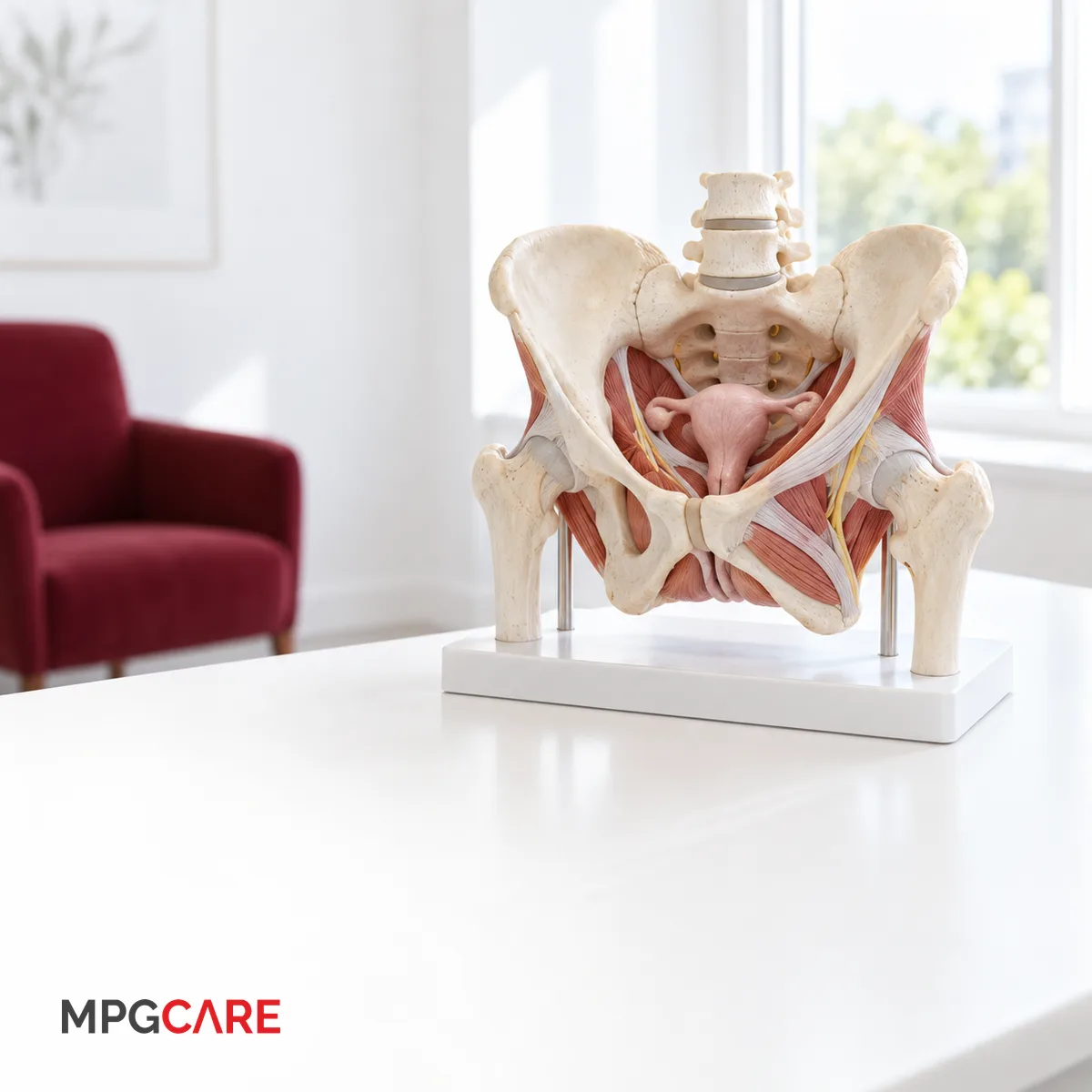
An inguinal hernia, also called a groin hernia, occurs when a piece of intestine or fatty tissue pushes through a weak spot in the lower abdominal wall, along the inguinal canal. It is the most common type of hernia: roughly one in four men develops an inguinal hernia at some point in life, compared with about one in thirty women.
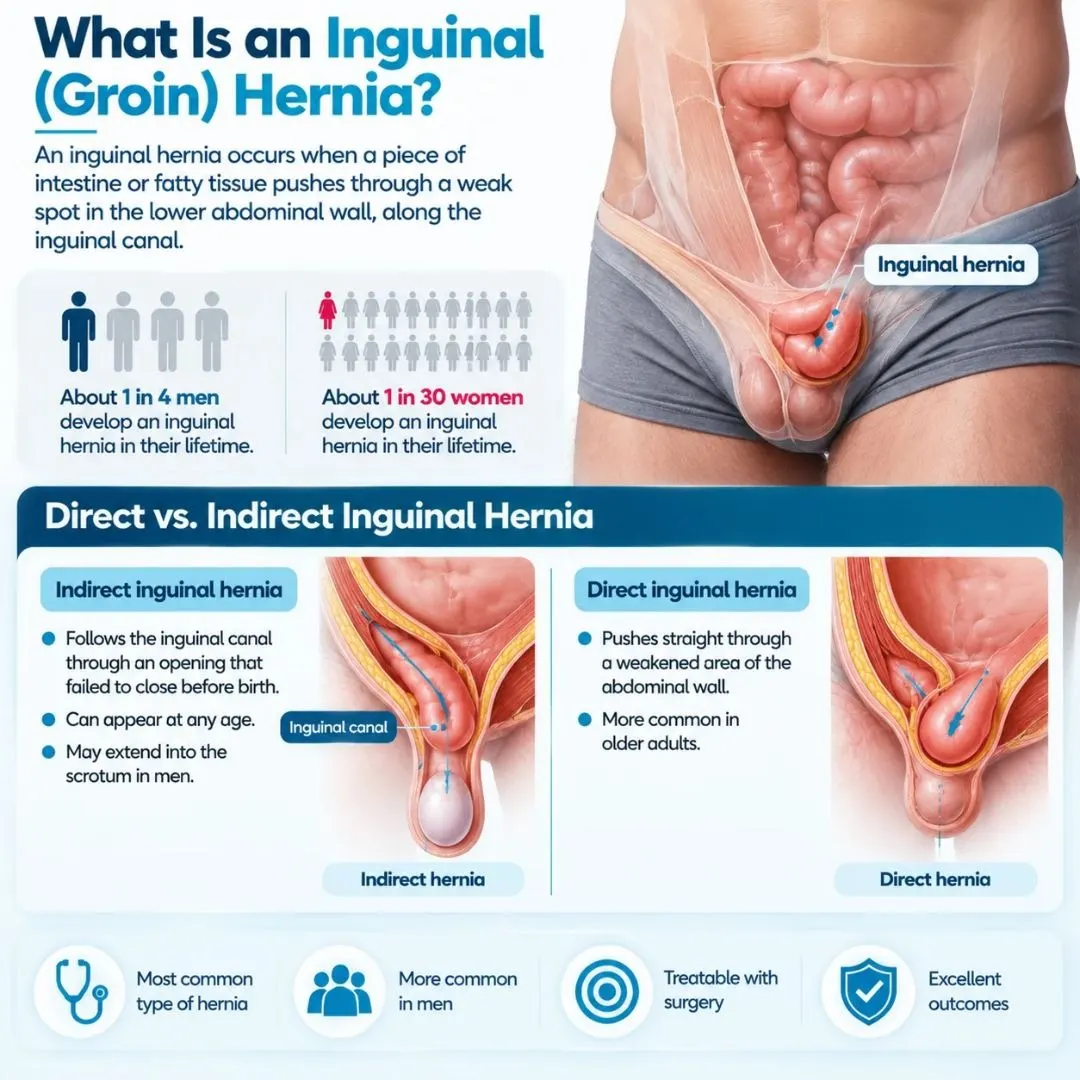
Direct vs. indirect inguinal hernia
An indirect inguinal hernia follows the path of the inguinal canal through an opening that failed to close before birth; it can appear at any age and may extend into the scrotum in men. A direct inguinal hernia pushes straight through a weakened area of the abdominal wall and is more common in older adults. Inguinal hernia symptoms are similar for both types; the difference matters mainly to the surgeon planning the repair.
Early Signs and Symptoms of an Inguinal Hernia
The earliest inguinal hernia signs are easy to overlook. Many people notice a soft lump in the groin that appears when standing and disappears when lying down, sometimes months before any real groin hernia pain begins. Recognizing these early symptoms of an inguinal hernia is what allows treatment before complications.
A bulge that comes and goes
The classic inguinal hernia symptom is a bulge on one side of the pubic bone. It becomes more visible when you stand, cough, laugh or strain, and often flattens or disappears when you lie flat. Some people can gently push the bulge back in; this is called a reducible inguinal hernia.
Pain, burning or a dragging sensation
Not every inguinal hernia hurts. When it does, groin hernia pain is usually described as aching, burning, stinging or a heavy “dragging” feeling rather than sharp pain. The discomfort is typically worse toward the end of the day and after long periods on your feet.
Symptoms that worsen when standing, coughing or lifting
Inguinal hernia symptoms are pressure-related. Anything that raises pressure inside the abdomen — coughing, sneezing, lifting, straining on the toilet, intense exercise — makes the bulge larger and the pain more noticeable. Improvement with rest is one of the most typical clues that groin pain is caused by a hernia.
What Does a Groin Hernia Feel Like?
Patients most often describe a groin hernia as a feeling of fullness or pressure low in the abdomen, near the crease where the thigh meets the body, sometimes with a “pulling” sensation when they stand up. Many notice groin swelling when standing up that is not there in the morning. Others feel a burning or tingling that radiates toward the inner thigh or, in men, toward the testicle. A small inguinal hernia may cause no sensation at all and only be found on examination.
Symptoms of Inguinal Hernia in Men
In men, symptoms of an inguinal hernia are typically noticed as a bulge in the groin area that becomes more prominent when standing, walking, coughing, or lifting heavy objects. A pulling sensation, burning, stinging, and groin pain that increases toward the end of the day are common complaints in men with an inguinal hernia.

In some men, an inguinal hernia may also cause discomfort radiating toward the testicle or a sense of fullness in the scrotum, in addition to the bulge. In people who stand for long periods or work in jobs that require regular physical effort, inguinal hernia symptoms may become noticeable more quickly.
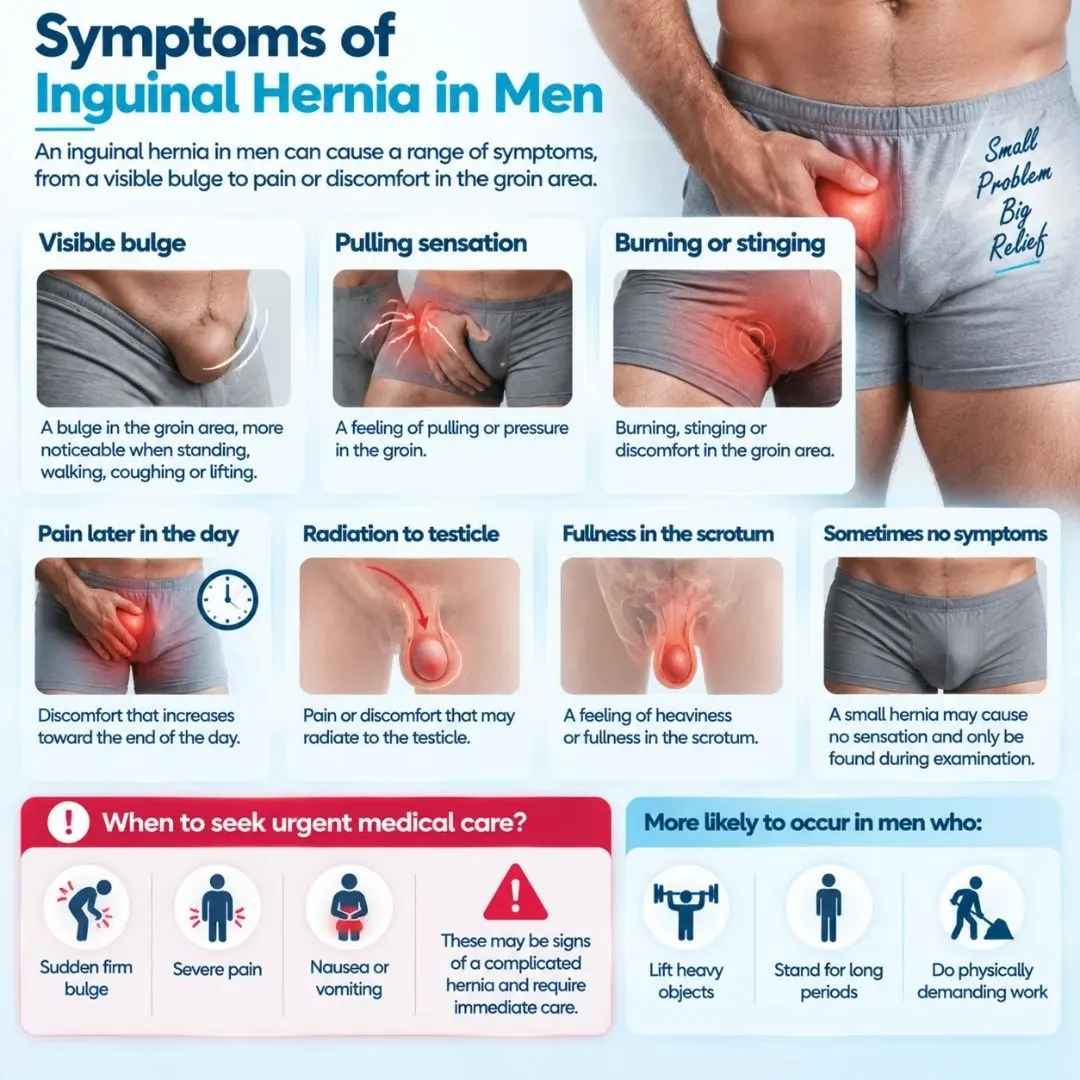
Especially if the bulge suddenly becomes firm, severe pain develops, or additional symptoms such as nausea and vomiting occur, the hernia may become an emergency, so seeking medical care without delay is important.
Testicular or scrotal swelling (“testicular hernia”)
What people search for as a “testicular hernia” is usually an indirect inguinal hernia that has travelled down the inguinal canal into the scrotum. Signs of a testicular hernia include a swollen scrotum on one side, a lump that enlarges when standing, a dragging ache in the testicle and, in some men, discomfort during intercourse or exercise. A doctor can usually distinguish a hernia from a hydrocele, varicocele or testicular problem by examination and, if needed, ultrasound.
Symptoms of Inguinal Hernia in Women

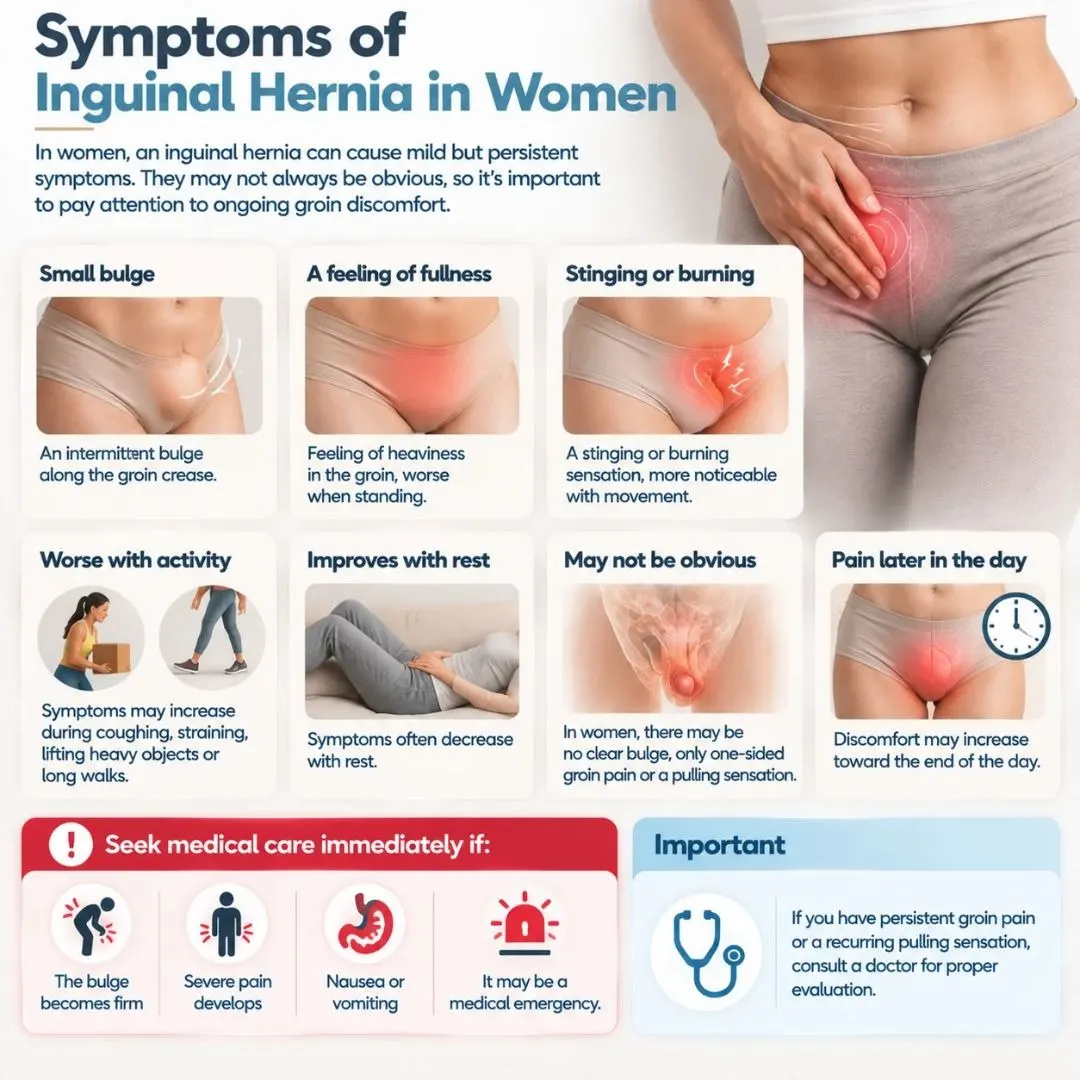
In women, symptoms of an inguinal hernia may sometimes present as “mild but persistent” complaints. Many women feel an intermittent small bulge along the groin crease, a sense of fullness that worsens when standing, and a stinging or burning sensation that becomes more noticeable with movement. Symptoms may increase during coughing, straining, lifting heavy objects, or long walks, and the fact that they decrease with rest can be a typical clue for an inguinal hernia.
In women, an inguinal hernia may not always be obvious with a clear bulge; therefore, one-sided groin pain, recurring pulling sensations, and discomfort that increases toward the end of the day should be carefully evaluated for a possible inguinal hernia.
If the bulge suddenly becomes firm or severe pain develops, or symptoms such as nausea and vomiting are added, it is important to seek care without delay, as an inguinal hernia can turn into an emergency.
Fluid buildup or swelling in the groin area in women
Women often search for “fluid buildup in the groin area” because a hernia in women can feel like soft swelling rather than a firm lump. A femoral hernia, which sits slightly lower in the groin crease, is also more common in women and is easily mistaken for an inguinal hernia or a swollen lymph node. Because inguinal hernia symptoms in women are subtler, they are more often misdiagnosed as a pulled muscle, ovarian pain or endometriosis. Persistent one-sided groin swelling in a woman deserves a surgical examination, not just observation.
Can an Inguinal Hernia Cause Bloating or Digestive Problems?
Yes. When part of the intestine sits inside the hernia sac, an inguinal hernia can cause bloating, a feeling of fullness after small meals, gurgling sounds in the groin and irregular bowel movements. These inguinal hernia side effects are usually mild and come and go. Constipation, nausea, or a sudden inability to pass gas or stool are different: they can signal that the bowel is trapped, and are covered in the warning signs below.
Complications and Warning Signs: Incarcerated and Strangulated Hernia
The shortest answer to “what are the complications of an inguinal hernia?” is this: if left untreated, an inguinal hernia may progressively worsen symptoms and, in some cases, lead to serious problems. At first, complications usually appear as pain that makes daily life more difficult, a burning or stinging sensation in the groin, and a gradually enlarging bulge. Over time, groin pain may increase during long walks, climbing stairs, or lifting heavy objects, and this can even lead to loss of work capacity.
The most important risk among inguinal hernia complications is strangulation. In this situation, the tissue within the hernia becomes trapped (incarcerated), blood supply may be impaired, and symptoms such as severe pain, a hardening bulge, and nausea and vomiting may occur. This scenario requires urgent evaluation.
When does an inguinal hernia become dangerous?
An inguinal hernia becomes dangerous when something suddenly changes from what you are used to. Seek emergency care the same day if:
- the bulge suddenly becomes firm and cannot be pushed back in
- groin pain rapidly becomes severe
- nausea, vomiting or abdominal bloating appear
- you cannot pass gas or stool
- the skin over the bulge turns red or purple, or there is fever
In short, an inguinal hernia is considered dangerous when the bulge “changes shape and hardens,” “pain increases rapidly,” and “symptoms such as nausea and vomiting are added.”
What happens if an inguinal hernia “bursts”?
The question “what happens if an inguinal hernia bursts?” is asked very often, because the term “burst” is commonly used to describe a sudden increase in the size of the bulge or trapping inside. Medically, an inguinal hernia does not “burst”; the real danger is that the tissue within the hernia becomes trapped and the blood circulation is compromised. If you feel that your hernia has “burst,” especially with rapidly increasing pain, waiting at home is not appropriate and emergency evaluation is needed.
How Is an Inguinal Hernia Diagnosed?
In most cases a general surgeon diagnoses an inguinal hernia with a physical examination: you stand, the doctor feels the groin, and asks you to cough or strain so the bulge becomes apparent. When the hernia is small, when symptoms are present without a visible lump (common in women), or when a testicular problem needs to be ruled out, an ultrasound of the groin is used. CT or MRI is reserved for unclear cases or before complex repairs. Blood tests are not needed to diagnose a groin hernia.
Does an Inguinal Hernia Need Surgery?
An inguinal hernia does not heal on its own, because the opening in the abdominal wall does not close. For a small, painless hernia in a man, watchful waiting is an accepted option, but most patients with inguinal hernia symptoms eventually choose repair, and any hernia in a woman or any hernia that causes pain is usually repaired. Surgery is the only definitive treatment.
Open vs. laparoscopic hernia repair
In open repair, the surgeon makes a small incision in the groin and reinforces the wall with a mesh. In laparoscopic (keyhole) repair, three tiny incisions and a camera are used; recovery is faster and it is preferred for hernias on both sides or recurrent hernias. Both are day-case or one-night procedures, and most patients return to desk work within one to two weeks.
Things to Watch Out for With an Inguinal Hernia
When it comes to things to watch out for with an inguinal hernia, the goal is to reduce factors that worsen symptoms and to avoid missing warning signs. In people with an inguinal hernia, lifting heavy objects, sudden straining, standing for long periods, and uncontrolled exercise can increase the bulge and pain. Therefore, if you need to carry a load, using proper lifting technique, sharing the load when possible, and avoiding excessive strain are important.
Constipation is also a common trigger for an inguinal hernia; a high-fiber diet, adequate water intake, and avoiding prolonged straining on the toilet may help reduce complaints. A long-lasting cough, smoking, or conditions such as chronic bronchitis can also increase pressure on the hernia and should be managed.
The most critical point to watch out for with an inguinal hernia is knowing the emergency signs described above. With regular follow-up and proper timing, the inguinal hernia process can be managed more safely and comfortably.
Inguinal Hernia Repair in Turkey with MPGCARE
International patients choose inguinal hernia surgery in Turkey because laparoscopic repair is performed routinely in high-volume general surgery departments, waiting times are short, and hospitals hold Ministry of Health and international accreditation. MPGCARE coordinates inguinal hernia repair with Medical Park group hospitals, including Medical Park Gebze, VM Medical Park Gebze (Kocaeli) and VM Medical Park Pendik, all within 20–30 minutes of Sabiha Gökçen Airport. You can review the general surgery and hernia repair services and the full list of partner hospitals before deciding.
The process is simple: send your examination report or ultrasound through our online assessment form; a general surgeon confirms the type of repair; we organize flights, accommodation and hospital transfers with an interpreter; and the first follow-up is done before you fly home. If groin swelling is your main complaint and you are not sure it is a hernia, our guide on what causes swelling in the groin explains the other possible causes.
Frequently Asked Questions

How do symptoms of an inguinal hernia most commonly begin?
In many people, symptoms of an inguinal hernia begin with a noticeable bulge in the groin and discomfort that increases with movement. The hernia may become more apparent when coughing, straining, or standing for long periods. Improvement with rest is also a common clue.
Do symptoms of an inguinal hernia always include a bulge?
No. In some people, the hernia bulge may be very small or not always visible. In that case, symptoms may present more as stinging, burning, a pulling sensation, and groin pain that worsens toward the end of the day.
Where can inguinal hernia pain radiate?
Although inguinal hernia pain is typically concentrated along the groin line, in some people it can radiate to the lower abdomen, thigh, or, in men, toward the testicle. Pain that increases with physical effort is characteristic.
Which symptoms suggest an inguinal hernia is dangerous?
If the hernia bulge suddenly becomes firm, cannot be pushed back in, and severe pain is accompanied by nausea and vomiting, the hernia may become an emergency. This can suggest a risk of entrapment/strangulation.
How do I know if it’s a hernia or a pulled groin muscle?
A pulled muscle hurts from the moment of injury, does not produce a lump, and improves within a couple of weeks. An inguinal hernia produces a bulge that changes with position, tends to get slowly worse over months, and does not go away with rest alone.
Can you exercise with an inguinal hernia?
Light activity such as walking is usually fine. Heavy lifting, sit-ups and high-impact sport increase abdominal pressure and can enlarge the hernia, so they should be avoided until after repair and cleared by your surgeon.
What is an inguinal hernia?
An inguinal hernia is the medical term for a groin hernia. In other words, it refers to a hernia in the groin region, and symptoms typically include a bulge and pain in that area.
What does “bilateral inguinal” mean?
“Bilateral inguinal” means that an inguinal hernia is present on both sides. In other words, both a right and a left inguinal hernia may exist; symptoms can be felt on both sides separately, or one side may be more prominent.
Can an inguinal hernia go away on its own?
An inguinal hernia typically does not disappear completely on its own. Symptoms may sometimes lessen, but because the opening that causes the hernia remains, it can become noticeable again over time. Therefore, if symptoms recur, evaluation is recommended.
What happens if an inguinal hernia is left untreated?
It usually grows slowly and becomes more uncomfortable. A small proportion of untreated hernias become incarcerated or strangulated, which requires emergency surgery. Planned repair is safer and has a faster recovery than emergency repair.
Is inguinal hernia surgery available for international patients in Turkey?
Yes. Laparoscopic and open inguinal hernia repair are performed in MPGCARE’s partner Medical Park hospitals for patients from abroad; the typical stay in Turkey is four to seven days including the first follow-up. Contact us with your report for a free assessment.
This article is for general information and does not replace an examination by a general surgeon. If you have a firm, painful groin bulge with nausea or vomiting, seek emergency care immediately.