

Corneal Transplant (Keratoplasty) in Turkey: Types, Recovery and What to Expect
Corneal transplant (keratoplasty) in Turkey: PK, DALK, DSAEK and DMEK compared, recovery timeline, success rates, graft rejection signs and how MPGCARE organizes your treatment abroad.
If glasses and contact lenses no longer give you clear vision because the front window of your eye has become scarred, swollen or cone-shaped, a corneal transplant may be the next step. Many of the patients we coordinate at MPGCARE arrive with the same three questions: which type of keratoplasty do I need, how long will recovery take, and why Turkey? This article answers all three.
What Is a Corneal Transplant and Who Needs One?
A corneal transplant (keratoplasty) replaces a damaged or diseased cornea, the clear dome at the front of the eye, with healthy tissue from a donor. Depending on which corneal layer is affected, the surgeon replaces either the full thickness of the cornea or only the diseased layer. It is the most frequently performed tissue transplant in the world.
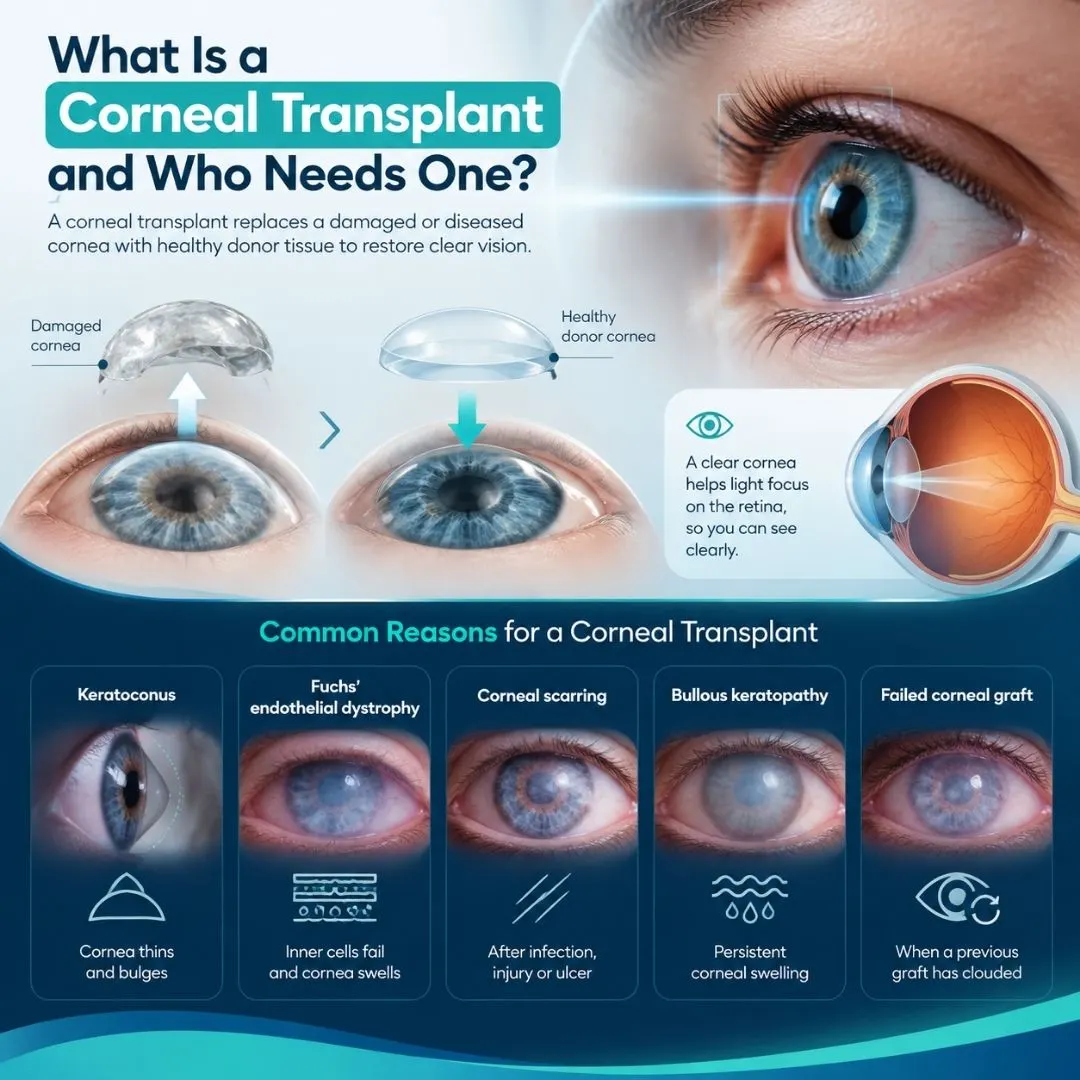
The cornea does most of the eye's focusing work. When it loses its transparency or shape, light no longer reaches the retina cleanly and vision blurs.
The most common reasons a cornea specialist recommends corneal transplant surgery are:
- Keratoconus: the cornea thins and bulges into a cone; a keratoconus corneal transplant is considered when cross-linking, rigid lenses or ring implants are no longer enough.
- Fuchs' endothelial dystrophy: the inner pumping cells fail and the cornea swells, often after age 50.
- Corneal scarring: after infection, ulcer, chemical or physical injury.
- Bullous keratopathy: persistent corneal swelling, sometimes after previous eye surgery.
- Failed corneal graft: a repeat corneal transplant when an earlier graft has clouded.
Whether you are a candidate is decided after a detailed corneal examination, not from symptoms alone. If you already have a diagnosis from your home country, you can send your reports through our online consultation request and the cornea surgeon reviews them before any travel is planned.
Types of Corneal Transplant: Full-Thickness vs Partial-Thickness
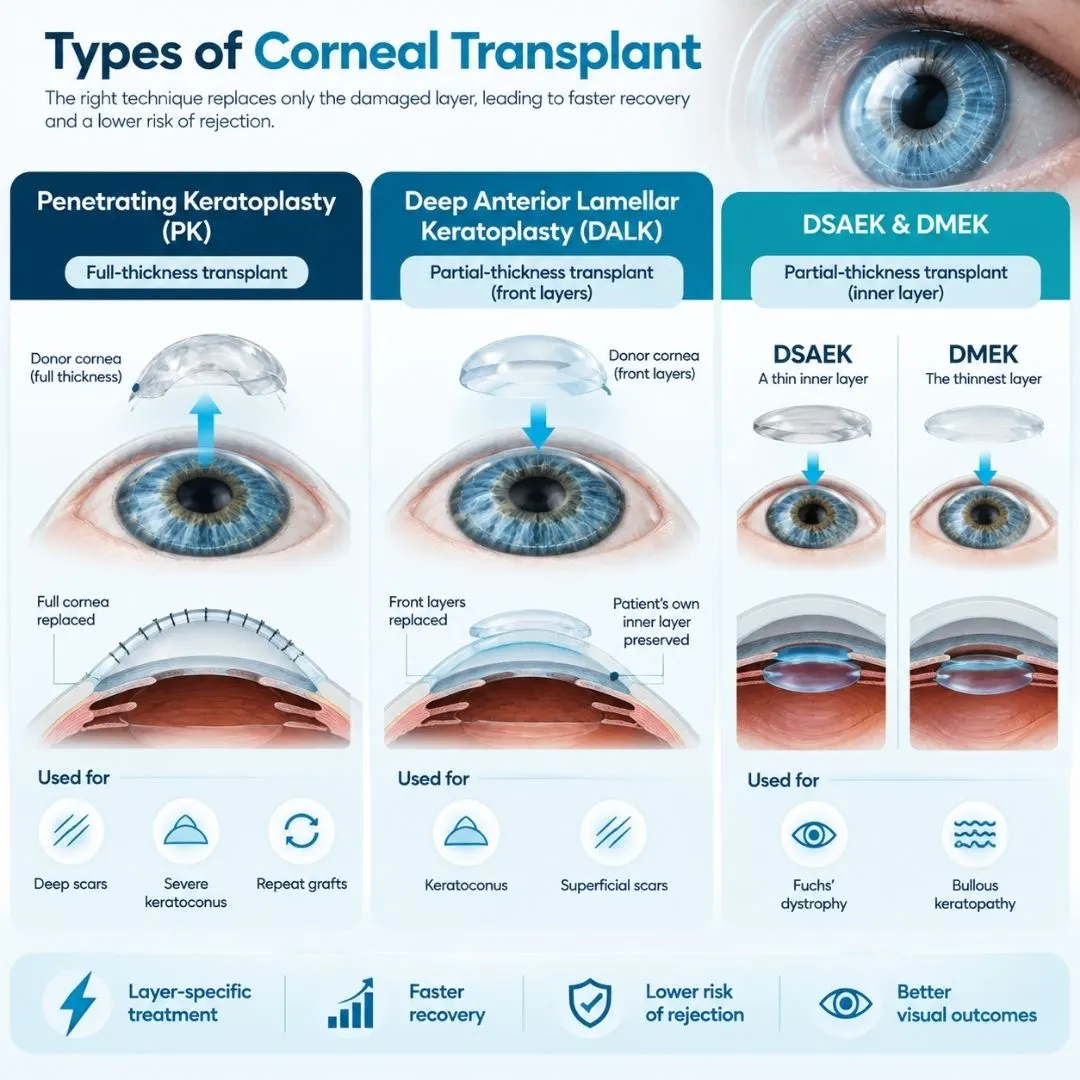
Modern keratoplasty is no longer one operation. The surgeon selects the technique that replaces only the layer that is actually damaged, which usually means a faster recovery and a lower risk of graft rejection.
Penetrating keratoplasty (PK)
The full-thickness corneal transplant. The entire central cornea is removed and replaced with a donor button held by very fine sutures. PK is still the right choice for deep scars, severe keratoconus with scarring and some repeat grafts.
Deep anterior lamellar keratoplasty (DALK)
A partial-thickness corneal transplant that replaces the front layers while preserving the patient's own inner endothelium. Because the endothelium is where most rejection starts, DALK is widely preferred for keratoconus and superficial scars.
DSAEK and DMEK (endothelial keratoplasty)
These replace only the thin inner layer. DMEK (Descemet membrane endothelial keratoplasty) transplants the thinnest possible tissue and typically gives the fastest visual recovery; DSAEK carries a slightly thicker donor layer and is easier to handle in complex eyes. Both are the standard corneal transplant options for Fuchs' dystrophy and bullous keratopathy.
| Technique | Layer replaced | Typical visual recovery |
|---|---|---|
| PK | Full thickness | 12–18 months |
| DALK | Front layers | 6–12 months |
| DSAEK | Inner layer (thicker graft) | 3–6 months |
| DMEK | Inner layer (thinnest graft) | Weeks to a few months |
A large German ten-year study found that DMEK patients reached driving-level vision in a median of about 8 months, compared with roughly 38 months after PK, while PK grafts showed the highest long-term survival. The best technique is therefore a balance between speed of recovery and long-term stability, decided case by case.
How Is Corneal Transplant Surgery Performed?
Corneal transplant surgery usually takes one to two hours and is performed under local anesthesia with sedation, or general anesthesia if the surgeon prefers. Most patients leave the hospital the same day or after one night.
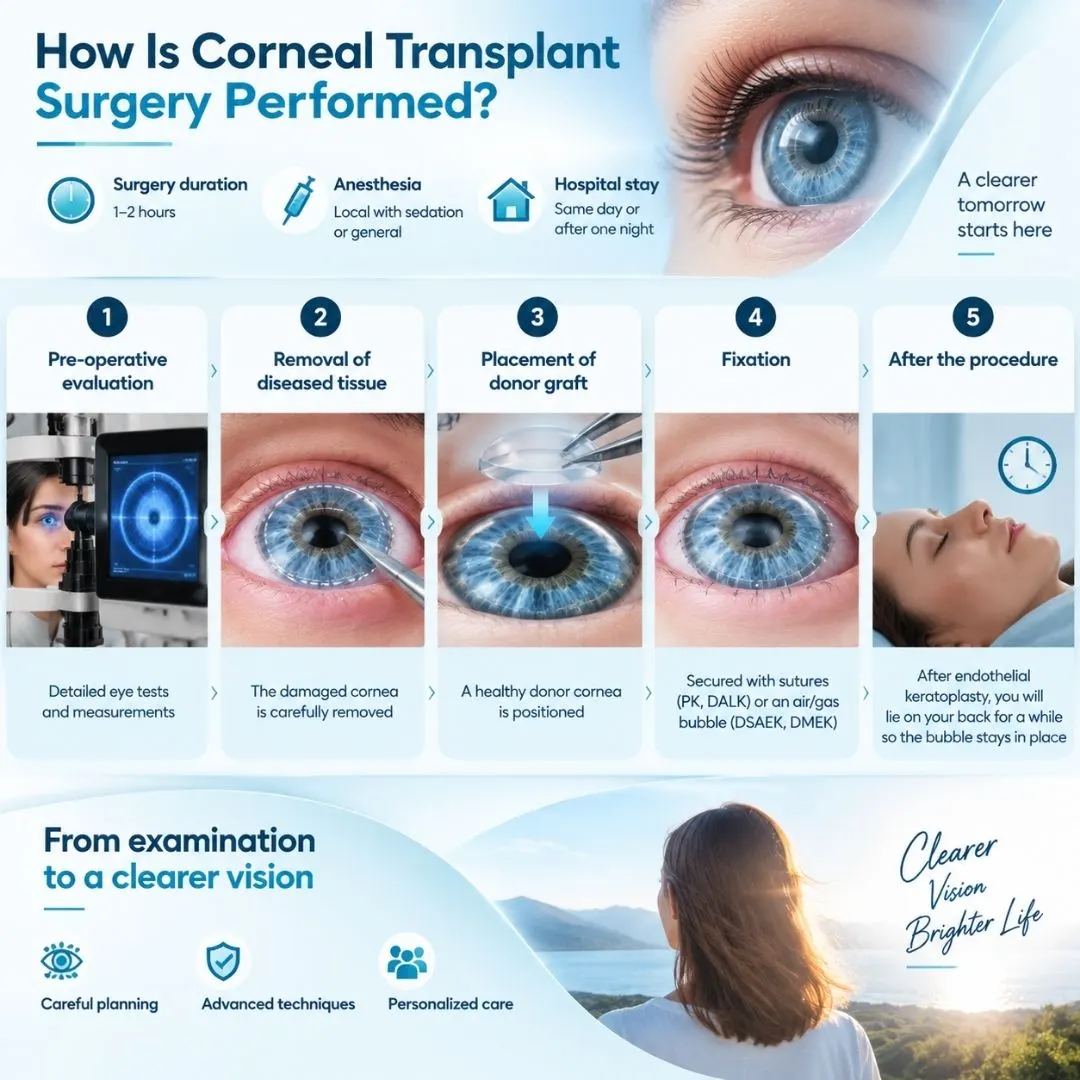
Before surgery, the cornea team maps the cornea, measures endothelial cell density and checks the rest of the eye. This pre-operative evaluation can be combined with a general check-up if you are travelling from abroad and want a full health picture before the operation.
During the procedure the surgeon removes the diseased corneal tissue, positions the donor graft and secures it with sutures (PK, DALK) or an air/gas bubble (DSAEK, DMEK). After endothelial keratoplasty you will be asked to lie on your back for a period so the bubble presses the graft into place.
Corneal Transplant Recovery: Timeline and Aftercare
Corneal transplant recovery time depends mainly on the technique. After DMEK many patients notice clearer vision within weeks; after a full-thickness corneal transplant, final vision can take a year or more because sutures are adjusted or removed gradually. Mild irritation, light sensitivity and fluctuating vision in the early weeks are expected.
| Period | What to expect |
|---|---|
| First week | Eye shield at night, frequent drops, first check-up |
| Weeks 2–6 | Vision starts to clear; light desk work is possible |
| Months 2–6 | Prescription stabilises after DMEK/DSAEK |
| 6–18 months | Suture removal and final glasses after PK/DALK |
Your surgeon will prescribe protective and anti-rejection eye drops; after a corneal transplant these are often continued for many months, and stopping them early is one of the most common causes of problems we see in patients who return for follow-up.
A practical example: if you work at a computer, you can usually resume within two to three weeks after DMEK. Heavy lifting, swimming and dusty environments need to wait longer, and any eye trauma must be avoided for life after PK because the graft never becomes as strong as the original cornea.
Success Rates, Risks and Graft Rejection
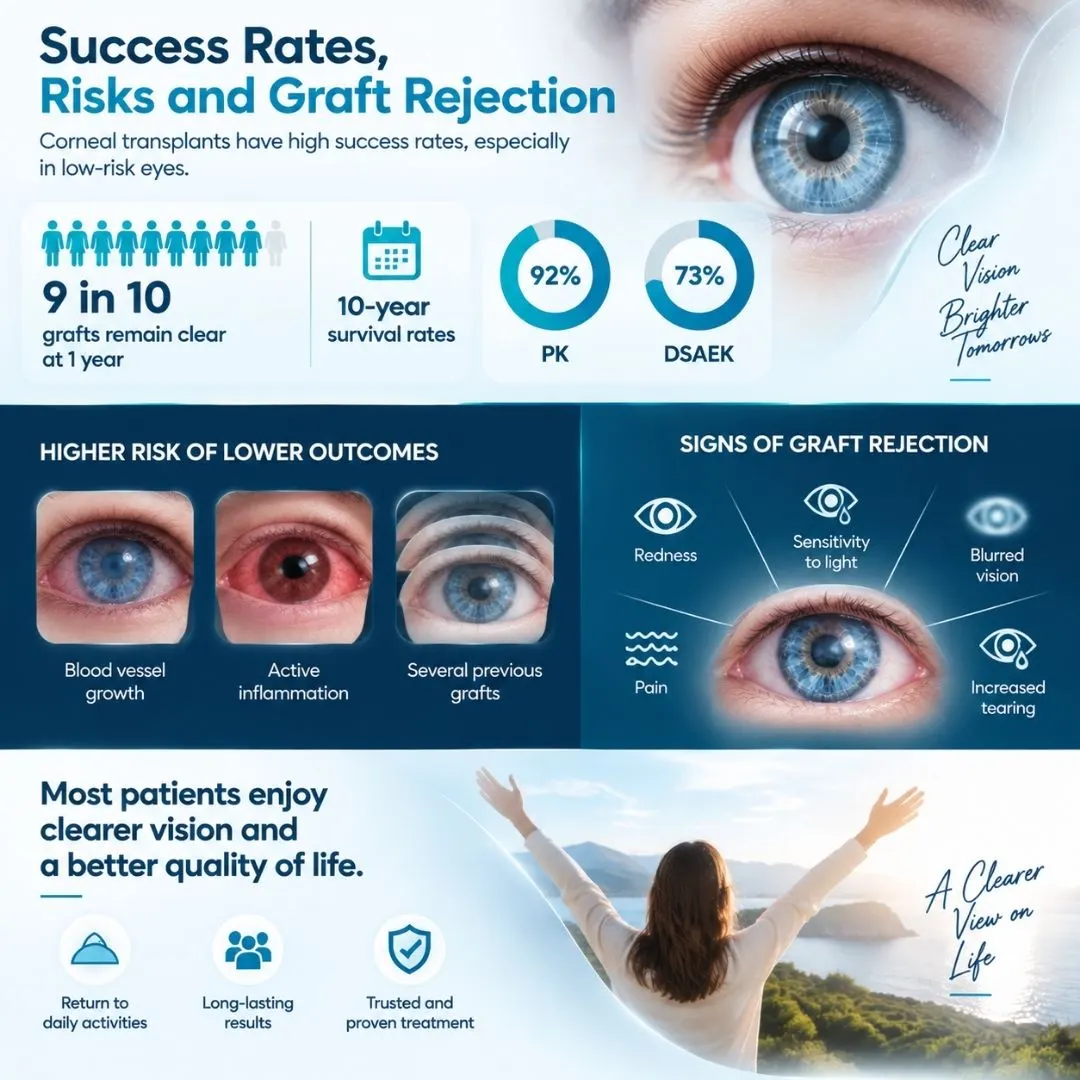
Corneal transplant success rates are high. For low-risk eyes, around nine in ten grafts remain clear at one year, and ten-year graft survival ranges from roughly 73 percent for DSAEK to 92 percent for PK in the study above. Outcomes are lower in high-risk eyes with heavy blood vessel growth, active inflammation or several previous grafts.
What is corneal graft rejection?
Graft rejection means your immune system attacks the donor tissue. It occurs in about one in ten transplants and is usually reversible if treated within days. Warning signs, sometimes summarised as RSVP, are:
- Redness that is new or increasing
- Sensitivity to light
- Vision that suddenly drops
- Pain or aching in the eye
If any of these appear, contact your eye doctor the same day. Because rejection can occur years later, this rule never expires.
Can a corneal transplant be repeated?
Yes. A failed graft can be replaced, and there is no fixed limit, but each repeat carries a somewhat higher rejection risk. This is one reason surgeons favour partial-thickness techniques when possible.
Why Patients Choose Turkey for Corneal Transplant
Corneal transplant in Turkey attracts international patients for three practical reasons: donor tissue is available through regulated eye banks, so waiting times are typically weeks rather than the months or years some countries report; cornea surgeons in high-volume centres perform DMEK, DALK and PK routinely; and hospitals hold Ministry of Health and international accreditation.
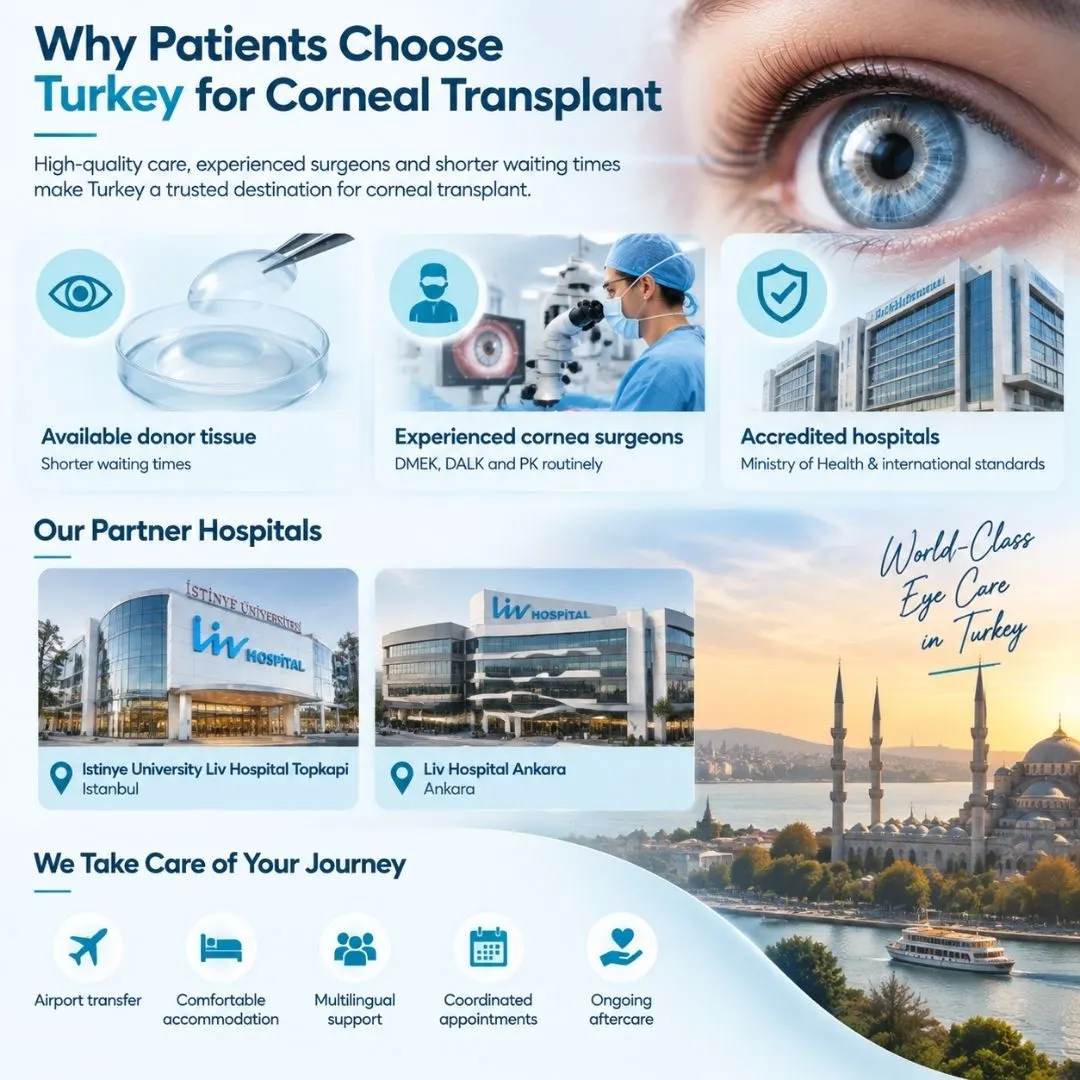
We coordinate corneal transplant surgery with partner hospital groups such as Liv Hospital and Medical Park, including Istinye University Liv Hospital Topkapi and Liv Hospital Ankara. You can browse the full partner hospital list and our contracted specialists before deciding.
What affects the overall cost?
We do not publish fixed prices because a corneal transplant abroad is priced case by case. The main variables are the technique (PK, DALK, DSAEK or DMEK), whether one or both eyes are treated, hospital stay, and the length of post-operative follow-up. Request a personalised quote and you will receive a written package with every item listed.
Corneal Transplant Abroad: How MPGCARE Organizes Your Treatment
Over the years we have noticed that eye patients worry less about the surgery than about logistics: flights, the air bubble, and who checks the eye after they go home. Our team handles the non-medical side so you can focus on healing.
- Online evaluation: send your reports and corneal scans; the surgeon confirms the suitable keratoplasty type.
- Travel and stay: we arrange flight tickets, accommodation and hospital transfers with an interpreter at every appointment. See our patient services.
- Follow-up: early check-ups are done in Turkey; longer-term controls are coordinated with your local ophthalmologist.
Flying home is usually possible 7 to 14 days after surgery, but after DMEK or DSAEK you must wait until the gas bubble has fully absorbed, because pressure changes at altitude can move the graft. Your surgeon gives the exact clearance date.
Frequently Asked Questions
How long does a corneal transplant last?
Many grafts stay clear for 10 years or more, and some for decades. Longevity depends on the technique, the original diagnosis and how consistently drops and check-ups are followed.
Is corneal transplant surgery painful?
The operation itself is not painful because the eye is anesthetised. Scratchiness and light sensitivity for the first days are normal and controlled with the drops your doctor prescribes.
Will I still need glasses after a corneal transplant?
Usually yes. A graft restores clarity, not focus, and astigmatism is common after PK. Glasses or contact lenses are typically fitted once the cornea has stabilised.
How quickly is donor cornea available in Turkey?
Corneas do not require tissue matching, so waiting times in partner hospitals are often measured in weeks. The exact timing is confirmed after your evaluation.
Can both eyes be transplanted at the same time?
Surgeons normally treat one eye first and the second after the first has healed, so that you always have one functioning eye during recovery.
Where do I start?
Send your reports through our contact page or WhatsApp; a cornea specialist reviews them within a few days.
This article is for general information and does not replace an examination by an ophthalmologist. Suitability for corneal transplant surgery is determined after a full eye evaluation.