Lump or Swelling in the Groin in Women: Hernia, Lymph Node, Cyst or Something Else?
Painful or painless lump in your groin? Learn the 8 most common causes of groin swelling in women — hernia, swollen lymph nodes, cysts, fluid buildup — and the signs that need a doctor.
A lump or swelling in the groin in women is usually harmless: most of the time it turns out to be a swollen lymph node reacting to a minor infection, a blocked hair follicle, or a small cyst. But the groin is also where hernias, fluid collections and, rarely, more serious problems show up, and in women these are missed far more often than in men. This guide walks through the eight most common causes of groin swelling in women, how each one feels, and which signs mean you should stop waiting and see a doctor.
We wrote it because “swelling in the groin” is one of the questions we hear most from women who contact MPGCARE, often after weeks of being told it was probably a pulled muscle.
Where Exactly Is the Groin, and Why Does Swelling There Worry Women?
The groin is the crease where the lower abdomen meets the top of the thigh. It is a crowded area: lymph nodes, the inguinal canal, the femoral vessels, the round ligament of the uterus and the top of the leg muscles all pass through a space a few centimetres wide. That is why a groin lump in women can have so many different explanations, and why it is easy to get the wrong one.
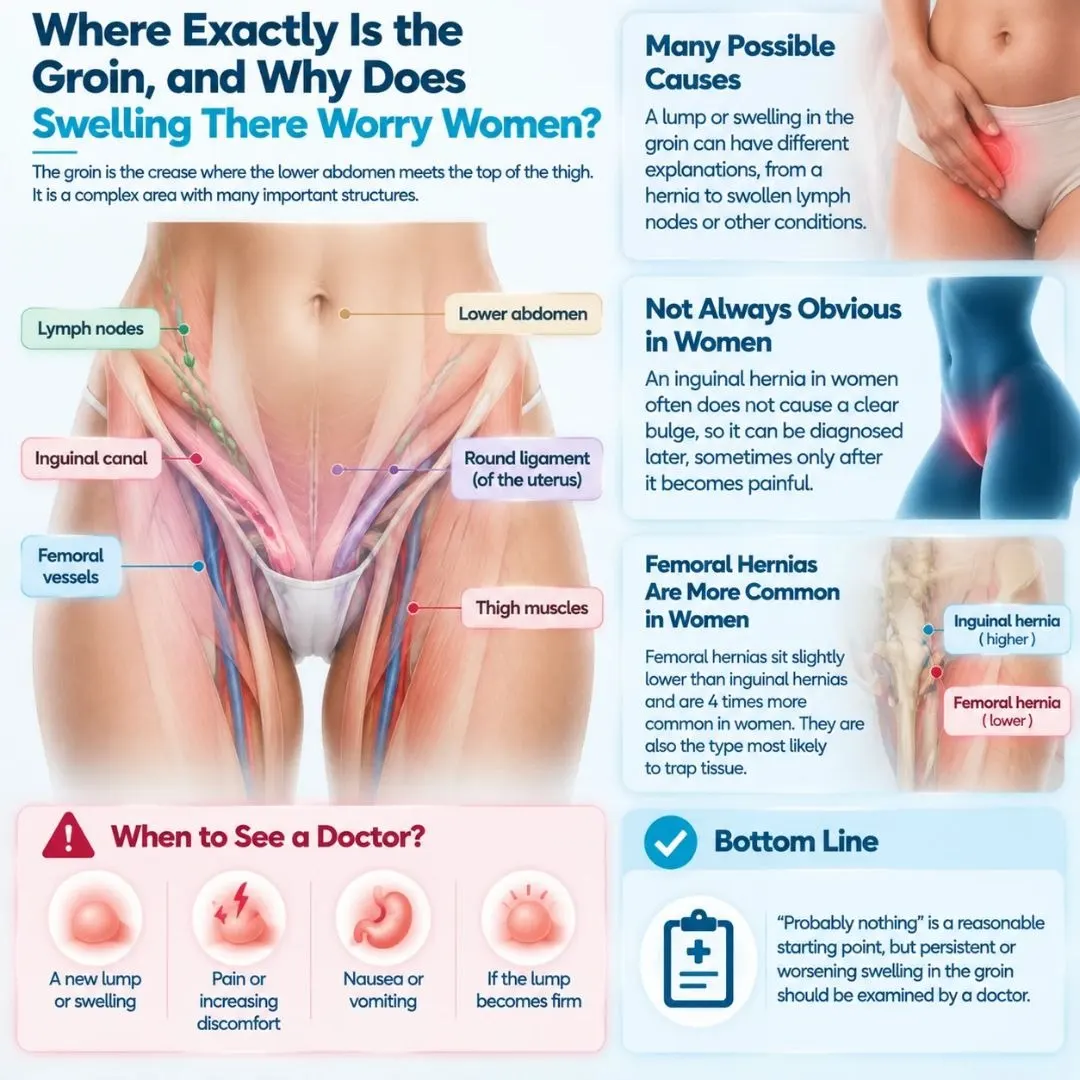
There is a second reason women worry, and it is justified. An inguinal hernia in a woman rarely produces the obvious bulge men get, so it is frequently diagnosed late, sometimes only after it has become painful. Femoral hernias, which sit slightly lower, are four times more common in women and are the type most likely to trap tissue. So “probably nothing” is a reasonable starting point, but not a reason to skip an examination.
Quick Guide: What a Groin Lump in Women Usually Means
| Cause | How it feels | Changes with standing or coughing? | How urgent |
|---|---|---|---|
| Swollen lymph node | Firm, pea- to grape-sized, often tender, may be several | No | See a doctor if it lasts more than 2–3 weeks |
| Inguinal hernia | Soft bulge, aching or dragging, worse late in the day | Yes, larger when standing | Non-urgent unless firm and painful |
| Femoral hernia | Small firm lump low in the crease, near the thigh | Sometimes | Assess promptly; higher risk of strangulation |
| Fluid buildup (cyst, seroma, lymphedema) | Soft, fluctuant, painless swelling | No | Non-urgent |
| Sebaceous cyst or abscess | Round lump in the skin, red and hot if infected | No | Urgent if red, hot, or feverish |
| Muscle or ligament strain | Diffuse tenderness, no distinct lump | Worse with movement | Non-urgent |
| Saphena varix (varicose vein) | Soft bluish swelling that empties when lying down | Yes | Non-urgent |
| Gynecological cause | Deep ache, may vary with the cycle | No | Depends on symptoms |
The 8 Most Common Causes of Groin Swelling in Women
1. Swollen lymph nodes in the groin
If you are wondering why the lymph node in your groin is swollen, the usual answer is that something below it is inflamed: a cut on the foot, an ingrown hair after shaving or waxing, athlete’s foot, a urinary or vaginal infection, or a sexually transmitted infection. The nodes enlarge, become tender, and settle within two or three weeks once the trigger clears.
A swollen lymph node in the groin that is painless, hard, fixed to the tissue around it, larger than about two centimetres, or still growing after three weeks needs to be looked at. Lymphoma and, less commonly, cancers of the skin of the leg, vulva or cervix can present this way. It is uncommon, but it is the reason a persistent node should never simply be watched at home.
2. Inguinal hernia in women
An inguinal hernia happens when abdominal contents push through a weak point in the inguinal canal. In women the swelling is often soft, low, and easy to mistake for a swollen gland or fatty tissue. What gives it away is behaviour rather than size: the lump appears or grows when you stand, cough or lift, and shrinks or disappears when you lie down. Many women also describe a pulling or burning feeling that radiates toward the inner thigh. We cover this in detail in our guide to inguinal hernia symptoms in women.
3. Femoral hernia
A femoral hernia comes through a narrow channel just below the inguinal ligament, so the lump sits lower, almost at the top of the thigh, and is usually small and firm. It is the hernia women get more often than men, particularly after pregnancies or significant weight loss. Because the opening is tight, a femoral hernia is more likely to trap a loop of bowel, which is why surgeons tend to recommend repair rather than observation.
4. Fluid buildup in the groin area: cysts, seroma and lymphedema
“Fluid buildup in the groin area” is how many women describe a soft, painless, slightly springy swelling that does not change with position. There are three common explanations. A cyst is a fluid-filled sac, often harmless and sometimes present for years. A seroma is a pocket of clear fluid that can collect after any surgery in the region, including caesarean section, hernia repair or lymph node removal. Lymphedema is swelling of the whole area, sometimes extending into the leg, when lymph drainage is blocked; it can follow pelvic surgery or radiotherapy. An ultrasound distinguishes the three in minutes.
5. Sebaceous cyst, abscess or ingrown hair
The skin of the groin has many sweat glands and hair follicles, and hair removal irritates them. A blocked gland produces a round, movable lump under the skin; if bacteria get in, it becomes an abscess: red, hot, throbbing, and sometimes accompanied by fever. Recurrent painful lumps in the groin creases and armpits can be a skin condition called hidradenitis suppurativa, which deserves a dermatologist rather than repeated courses of antibiotics.
6. Pulled groin muscle or inguinal ligament strain
A strained adductor muscle or inguinal ligament causes tenderness spread across the crease, worse when you bring your legs together, climb stairs or get out of a car. It usually starts after a specific movement, sport or fall. There is swelling but no discrete lump, and it improves over two to four weeks with rest. Pain that does not improve, or that comes with a bulge, is not a strain and should be re-examined.
7. Varicose veins or a saphena varix
A saphena varix is a bulge in the main superficial vein of the leg where it joins the deep vein in the groin. It is soft, sometimes bluish, has a faint cough impulse just like a hernia, and disappears completely when you lie flat. It is harmless in itself, but it is regularly mistaken for an inguinal hernia, and it is worth knowing about if you also have varicose veins lower down the leg.
8. Gynecological causes: ovarian cyst, endometriosis and round ligament pain
Not every groin swelling in women starts in the groin. A large ovarian cyst can cause fullness and aching that is felt low on one side. Endometriosis occasionally involves the inguinal canal and produces a tender lump that swells during menstruation. And in pregnancy, the round ligament that anchors the uterus stretches and can cause sharp groin pain with a sensation of swelling, most often in the second trimester. If your groin symptoms track your cycle or your pregnancy, a gynecologist should be part of the evaluation.
Is It a Hernia or a Swollen Lymph Node? How to Tell the Difference
This is the question we are asked more than any other, so here is a practical comparison. It is a guide, not a diagnosis; a surgeon can usually settle it in a two-minute examination.
| Inguinal hernia | Swollen lymph node | |
|---|---|---|
| Position | Above the crease, toward the pubic bone | In the crease itself, often several in a row |
| Texture | Soft, sometimes gurgles | Firm, rubbery, distinct edges |
| Standing or coughing | Gets bigger | No change |
| Lying down | Shrinks or disappears | Stays the same |
| Can you push it back in? | Often yes | No |
| Pain | Aching, dragging, worse late in the day | Tender to touch, especially with infection |
If you want to understand how an inguinal hernia feels day to day, our symptoms guide describes it in patients’ own words.
Painful vs. Painless Groin Lump in Women: What the Difference Tells You
Pain narrows the list. A painful swelling in the groin in a woman most often means infection or inflammation: an abscess, an inflamed lymph node, a strained muscle, or, more seriously, a hernia that has become trapped. A painless lump points toward a cyst, a simple hernia, a saphena varix, or a lymph node that has enlarged slowly.
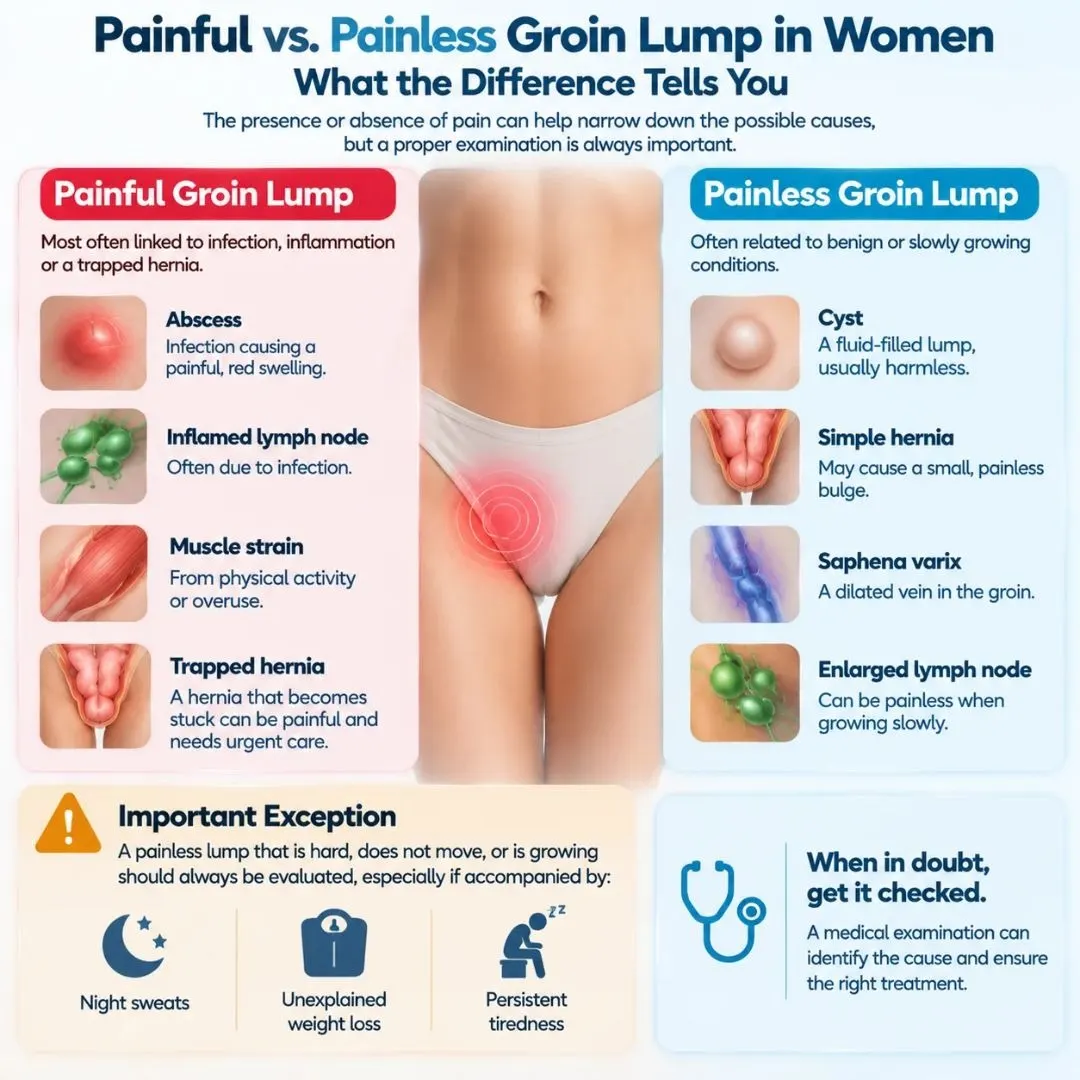
The exception that matters is a painless lump that is hard and does not move. Painless is not the same as safe when the lump is fixed, growing, or accompanied by night sweats, unexplained weight loss or persistent tiredness.
Groin Swelling That Changes: When Standing, During Your Period, or in Pregnancy
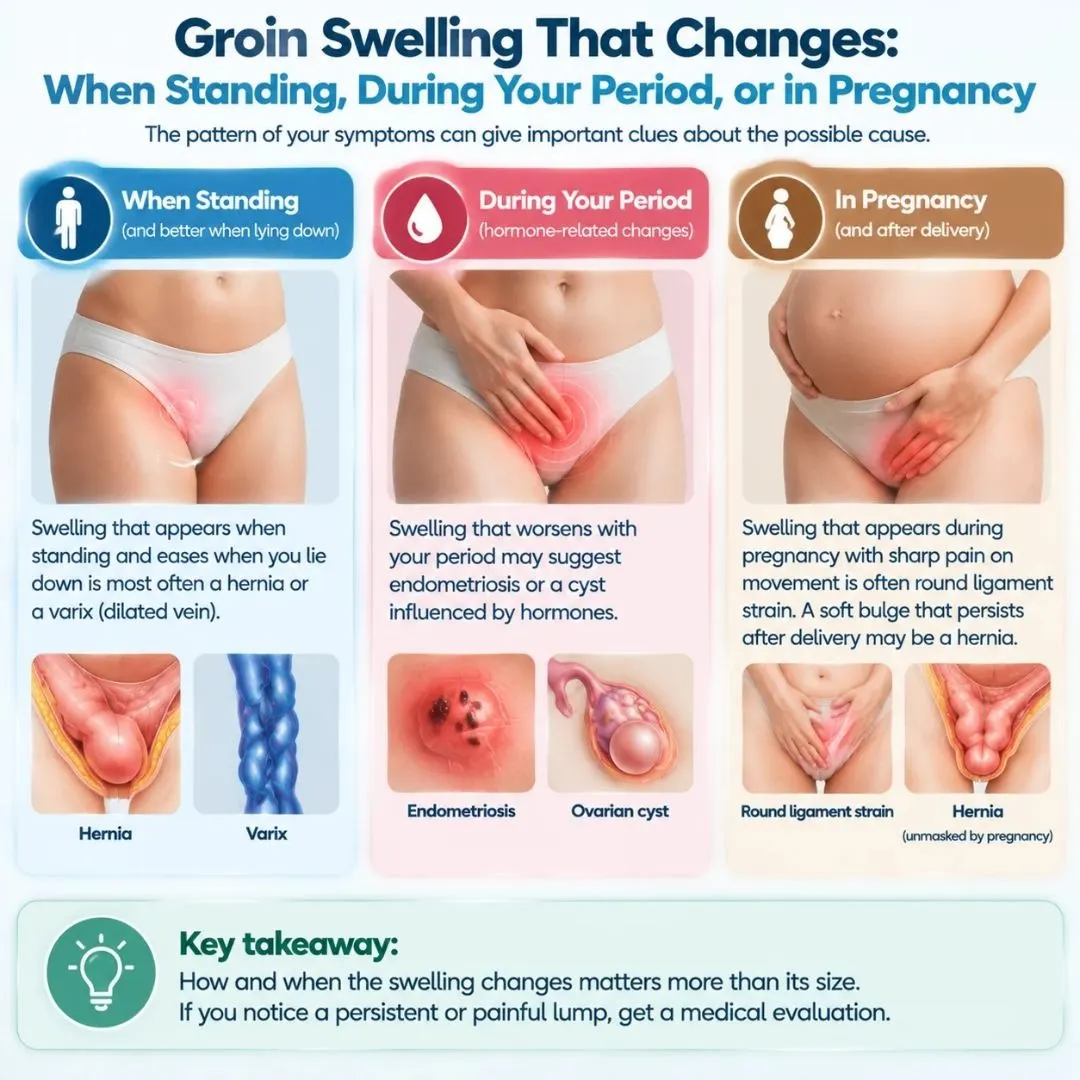
A pattern is often more useful than the size of the lump. Groin swelling when standing up that eases when you lie down is nearly always a hernia or a varix. Swelling that flares with your period suggests endometriosis or a cyst under hormonal influence. Swelling that appeared during pregnancy and is accompanied by sharp pain on turning in bed is most often round ligament strain; a soft bulge that persists after delivery may be a hernia that pregnancy unmasked.
Warning Signs: When a Groin Lump Needs a Doctor Urgently
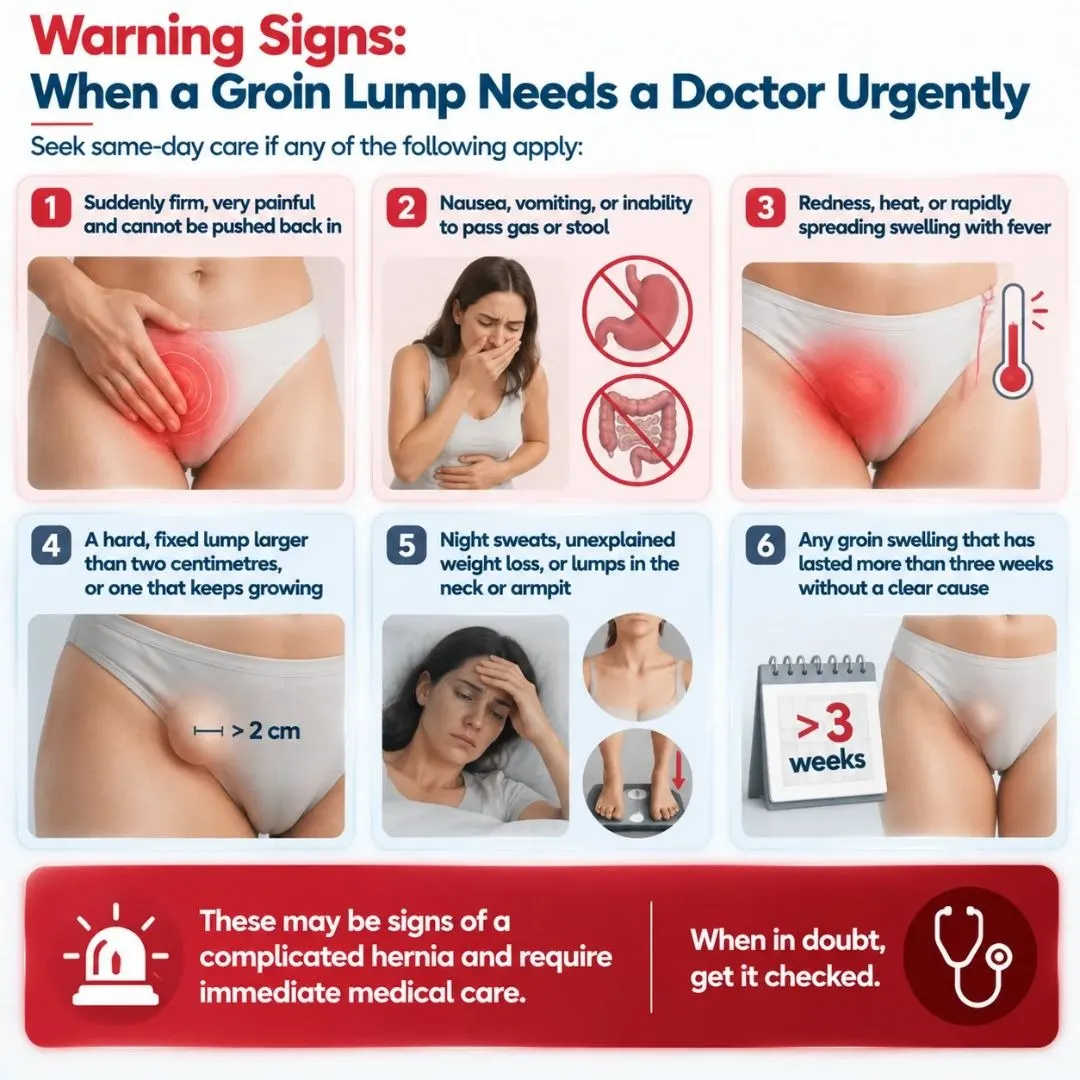
Seek same-day care if any of the following apply:
- The lump has suddenly become firm, very painful, and cannot be pushed back in
- Nausea, vomiting, or inability to pass gas or stool alongside a groin bulge
- Redness, heat, or rapidly spreading swelling with fever
- A hard, fixed lump larger than two centimetres, or one that keeps growing
- Night sweats, unexplained weight loss, or lumps in the neck or armpit at the same time
- Any groin swelling in a woman that has lasted more than three weeks without a clear cause
The first two describe an incarcerated or strangulated hernia, which is a surgical emergency.
How Doctors Diagnose a Groin Lump in Women
The examination is simple: you stand, the doctor feels the lump, asks you to cough, then repeats the check lying down. That alone separates most hernias from lymph nodes. An ultrasound of the groin is the standard next step. It shows whether the swelling is fluid, solid or bowel, and it is painless and quick. Blood tests are added if infection or a blood disorder is suspected, and a needle sample or biopsy if a lymph node looks abnormal. CT or MRI is reserved for unclear cases.
Which specialist you see depends on the likely cause. A general surgeon handles hernias, cysts and lymph node biopsies; a gynecologist evaluates ovarian and endometriosis-related causes; a dermatologist manages recurrent skin abscesses. In practice, a general surgeon is the right first stop for most groin lumps in women.
Treatment Options for Groin Swelling in Women
Treatment follows the cause. Reactive lymph nodes need nothing beyond treating the infection. A simple cyst can be watched or drained. An abscess is drained and sometimes treated with antibiotics. A hernia in a woman is usually repaired, either through a small groin incision or laparoscopically with three keyhole incisions; both are day procedures with a return to desk work within one to two weeks. Gynecological causes are managed by the gynecologist, and suspicious lymph nodes are biopsied before any decision.
Groin Lump Evaluation and Treatment in Turkey with MPGCARE
Many of the women who contact us have already spent months between appointments in their home country without a definite answer. In Turkey, the examination, ultrasound and a same-day consultation with a general surgeon and, if needed, a gynecologist can be completed in a single visit, and hernia repair can be scheduled within days rather than months. MPGCARE coordinates this with accredited partner hospitals in Istanbul and Kocaeli, arranges flights, accommodation and transfers with an interpreter, and can combine the assessment with a full health check-up if you want a broader picture. Send a short description of your symptoms or an ultrasound report through our online assessment form and a surgeon reviews it before you travel. For groin swelling that is not specific to women, our guide on what causes swelling in the groin covers the remaining causes.
Frequently Asked Questions
Why is there a lump in my groin that comes and goes?
A lump that appears when you stand or strain and disappears when you lie down is almost always a hernia or a saphena varix. Lymph nodes and cysts do not behave this way. A surgeon can tell the two apart in minutes.
Can a swollen lymph node in the groin be cancer?
Rarely. Most swollen groin nodes are reacting to infection or skin irritation. A node that is hard, painless, larger than two centimetres, fixed, or still enlarging after three weeks should be examined and, if necessary, biopsied.
What does fluid buildup in the groin feel like?
Soft, slightly springy, usually painless, and unchanged by standing or coughing. It is typically a cyst, a seroma after surgery, or lymphedema, and an ultrasound identifies which.
Is a groin lump in women more likely to be a hernia or a lymph node?
Lymph nodes are more common overall, but hernias are underdiagnosed in women precisely because they are assumed to be nodes. If the lump changes with position, think hernia first.
Can an ovarian cyst cause swelling in the groin?
A large ovarian cyst can cause aching and a sense of fullness low on one side that women describe as groin swelling, although the cyst itself is in the pelvis. Symptoms that track your cycle point toward a gynecological cause.
How long should I wait before seeing a doctor about a groin lump?
Three weeks for a painless lump with no other symptoms. Sooner if it is painful, growing, red, or if you have fever. Same day if it is firm, cannot be pushed in, and comes with nausea or vomiting.
Which doctor should I see for groin swelling?
Start with a general surgeon; they evaluate hernias, lymph nodes and cysts, and will refer you to a gynecologist or dermatologist if the cause lies there.
This article is for general information and does not replace an examination. A new, persistent or painful lump in the groin should always be assessed by a doctor.